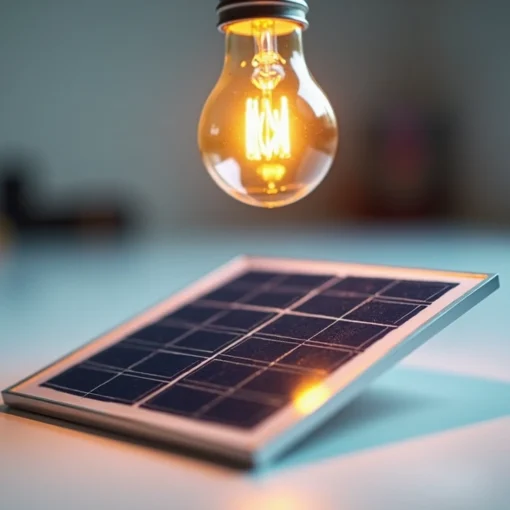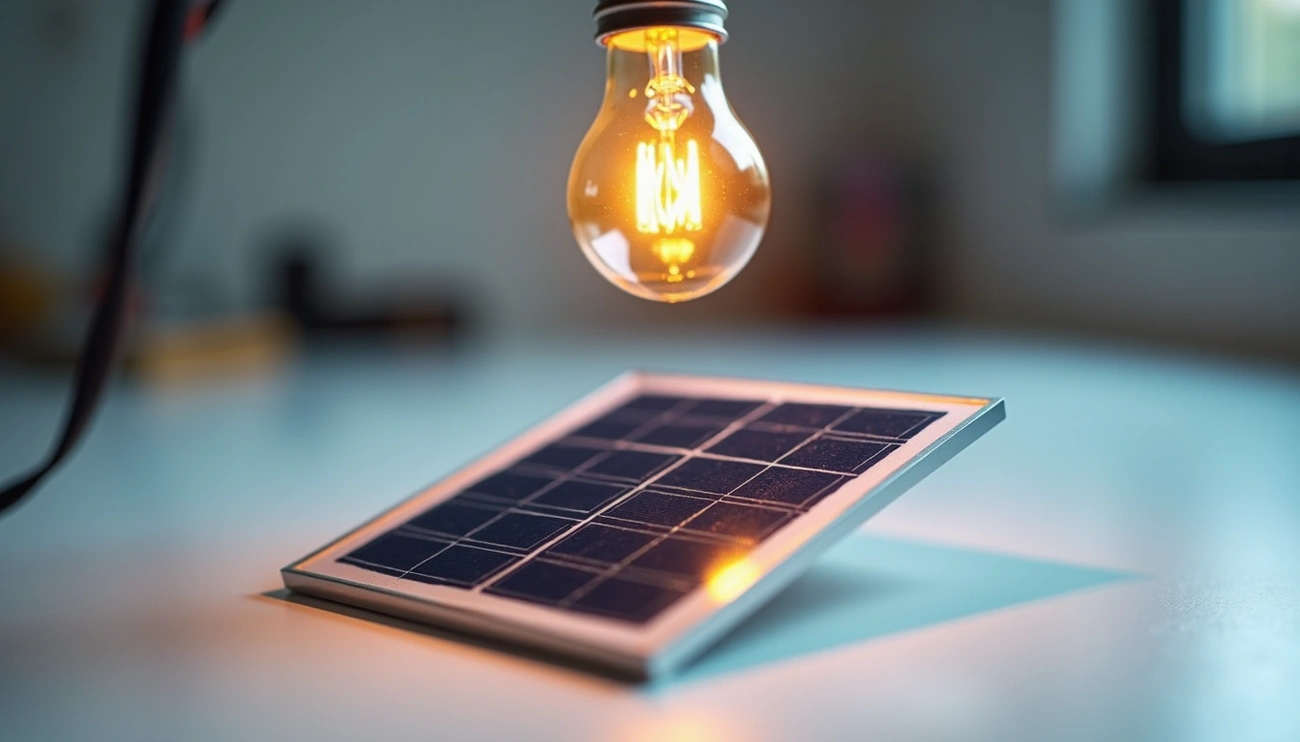
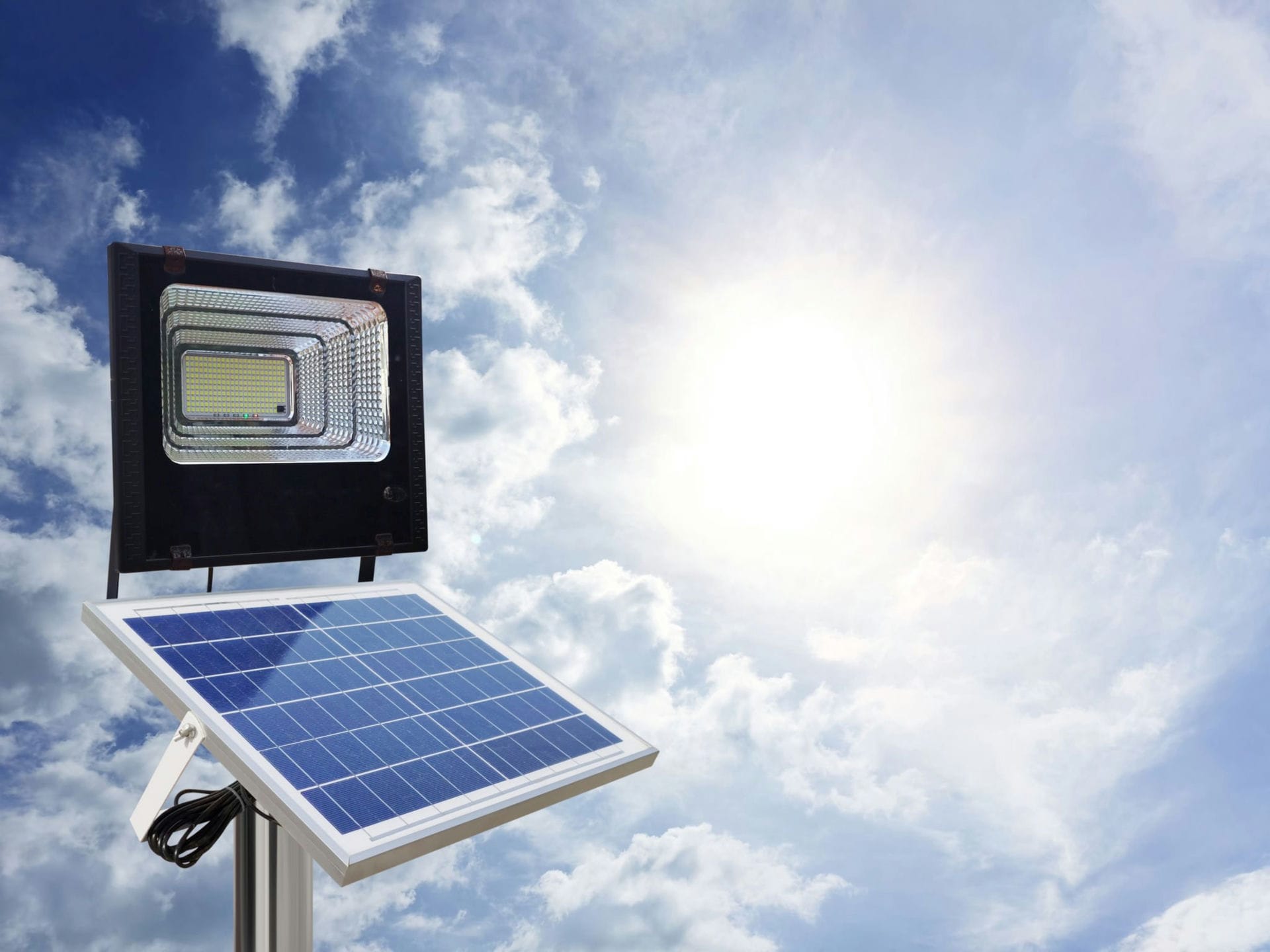
LED light can charge solar panels, but the process is extremely inefficient. Solar cells convert artificial light into electricity, yet LED light produces far less usable energy than direct sunlight—often about 100 times less effective. LED lighting can only provide small trickle-charging for low-power devices.
The Science: How LED Light Interacts with Solar Panels
Photovoltaic Effect Explained
Solar panels convert light into electricity through the photovoltaic effect. When photons strike a photovoltaic cell, they transfer energy to electrons in the semiconductor material. This energy boost allows electrons to break free from their atoms and flow through the material as electrical current.
The process happens within a p-n junction, where two types of semiconductors meet. By joining p-type and n-type semiconductors, an electric field forms at the junction as electrons move to the positive p-side and holes move to the negative n-side. This built-in field directs the freed electrons toward an external circuit where they can do useful work.
How LED Light Wavelengths Work
LEDs produce light through electroluminescence. When electrical current passes through an LED, electrons recombine with holes in the material, releasing energy as photons. The wavelength of an LED is mainly determined by the bandgap width of its semiconductor material, calculated using the formula λ=1240/Eg.
Most LED lamps emit visible light with wavelengths between 380 and 780 nanometers. Red LEDs operate between 610-700nm, while blue LEDs work in the 450-490nm range. However, LED light differs from sunlight in one critical way. Sunlight provides a continuous spectrum from ultraviolet to infrared, while LED spectrums concentrate in specific wavelength ranges.
Why Solar Panels Respond to LED Light
Solar panels respond to LED light because the photovoltaic effect works with any light source that delivers photons with sufficient energy. The semiconductor’s bandgap determines what wavelengths the material can absorb and convert to electrical energy. When the light wavelength matches the bandgap, the cell can make use of the available energy.
Consequently, solar panels can convert artificial light into electricity. The interaction follows the same mechanism whether photons come from the sun or an LED bulb. Photons still excite electrons, and those electrons still flow through the p-n junction to create current.
The Role of Light Intensity
Light intensity directly impacts solar panel output. The light intensity on a solar cell is measured in units called ‘suns’, where 1 sun equals 1 kW/m². Short-circuit current from a solar cell depends linearly on light intensity. A device operating under 10 suns would produce 10 times the short-circuit current as the same device under one sun.
Open-circuit voltage, however, increases logarithmically with light intensity. A doubling of light intensity causes only an 18 mV rise in voltage. At low light levels, shunt resistance becomes increasingly important, as the fraction of current flowing through the shunt resistance rises, thereby increasing fractional power loss.
LED Light vs. Sunlight: The Critical Power Gap
Measuring Light Intensity in Real Numbers
Direct sunlight delivers between 32,000 to 100,000 lux on Earth’s surface. Full daylight ranges from 10,000 to 25,000 lux, while an overcast day measures around 100 lux. In contrast, office lighting provides only 400-500 lux. Your brightest indoor LED bulbs can’t compete with even cloudy weather conditions.
Measured in watts per square meter, direct sunlight delivers approximately 1,000 W/m². Indirect light from clouds drops this to 50-300 W/m² depending on weather conditions. Indoor artificial lighting produces far less irradiance than these values.
Spectrum Comparison: LED vs Natural Sun
Sunlight produces a continuous, smooth spectral power distribution containing all wavelengths without significant peaks or gaps. This completeness gives sunlight a perfect Color Rendering Index of 100. Standard LEDs, however, show a sharp blue spike between 440-460 nm with notable deficits in light blue and red ranges. Conventional LEDs emit strong blue components but weak green and yellow components compared to natural sunlight.
Full-spectrum LEDs attempt to close this gap using sophisticated phosphor combinations, achieving CRI values of 95-99% with color temperatures of 5,000K-6,500K. Nevertheless, they still can’t perfectly replicate the sun’s even distribution.
Why Distance from Light Source Matters
Light spreads out as it leaves its source, but the total amount of light remains constant. As the coverage area grows larger, the amount of light per unit area gets smaller and weaker. For instance, 1,000 lumens concentrated into one square meter produces 1,000 lux. That same 1,000 lumens spread over 10 square meters drops to just 100 lux.
Energy Output Under Different Lighting Conditions
A 400W solar panel produces around 400 watts under ideal direct sun. Under thick cloud cover, output falls to 40-100 watts. That represents a 60-90% drop in real-time performance.
Why LED Light Charging is Extremely Inefficient
The Double Energy Loss Problem
Artificial light creates a conversion nightmare that solar panels can’t overcome. Incandescent bulbs convert only about 10% of their energy into visible light, with the rest becoming heat. Solar panels themselves convert just 15-20% of the light hitting them into electricity. You’re stacking inefficiencies on top of inefficiencies.
Here’s what actually happens: your electrical outlet provides power to a bulb, which converts most of that energy to heat and only a fraction to light. The solar panel then captures that weak light and converts another small fraction back to electricity. Studies show artificial light produces only about 10-25% of the energy capture you’d get from direct sun exposure.
This double conversion process guarantees a net energy loss. Inasmuch as you’re paying for grid electricity to create artificial light, and that light generates far less electrical energy than you spent, the math never works in your favor.
Time Required for Meaningful Charging
LED charging demands patience for minimal results. You’ll need 6-12 hours of continuous exposure to achieve even a partial charge. Indoor lights can charge solar lights, but efficiency remains extremely low because indoor light intensity measures hundreds of times weaker than natural sunlight.
This extended charging period compounds the economic problem. Running an LED bulb for 12 hours to partially charge a small solar device means burning through grid electricity the entire time.
Cost Analysis: Electricity Used vs Energy Generated
The economics reveal the fundamental flaw. It takes more energy to power the light bulb than the solar panel can produce. You’re literally spending more on electricity than you’re generating. The electricity cost exceeds any benefit you’d receive. No scenario exists where this approach makes financial sense for practical applications.
When LED Light Charging Actually Makes Sense
Small Devices That Work with LED Charging
Small solar garden lights represent the most practical application for LED charging. These devices contain tiny panels designed for low-power operation, typically requiring only 10-45 lumens. Solar calculators, decorative pathway lights, and compact solar chargers fall into this category. Their minimal energy demands mean artificial light can provide enough power to function, even if slowly.
Educational and Testing Purposes
LED charging serves well for demonstrating photovoltaic principles in classrooms or testing whether a solar panel works properly. You can verify a panel’s basic functionality without waiting for sunny weather. This approach helps you troubleshoot issues or understand solar cell behavior without committing to full-scale installations.
What Type of LED Bulbs Work Best
Position your solar panel approximately 12 inches from a bright LED bulb for optimal results. Use LED bulbs with color temperatures between 5000K and 6500K, which closely mimic natural daylight. Your bulb should output at least 2000-3000 lumens. Expect 10-12 hours for a complete charge.
Better Alternatives for Indoor Solar Applications
Solar-rechargeable LED bulbs offer a more sensible solution. These units include built-in solar panels and 1200mAh batteries providing 4-6 hours of lighting. Portable solar power banks work better than trying to charge panels with artificial light. You spend less time searching for outlets and gain genuine portability.
Conclusion
LED lights can charge solar panels, but the efficiency gap makes it impractical for most applications. You’re getting less than 1% of the sun’s power, and the double conversion process guarantees you’ll spend more on electricity than you’ll generate. The math simply doesn’t work in your favor.
Save LED charging for small garden lights, educational demonstrations, or panel testing. For actual indoor solar applications, we recommend dedicated solar-rechargeable devices instead.