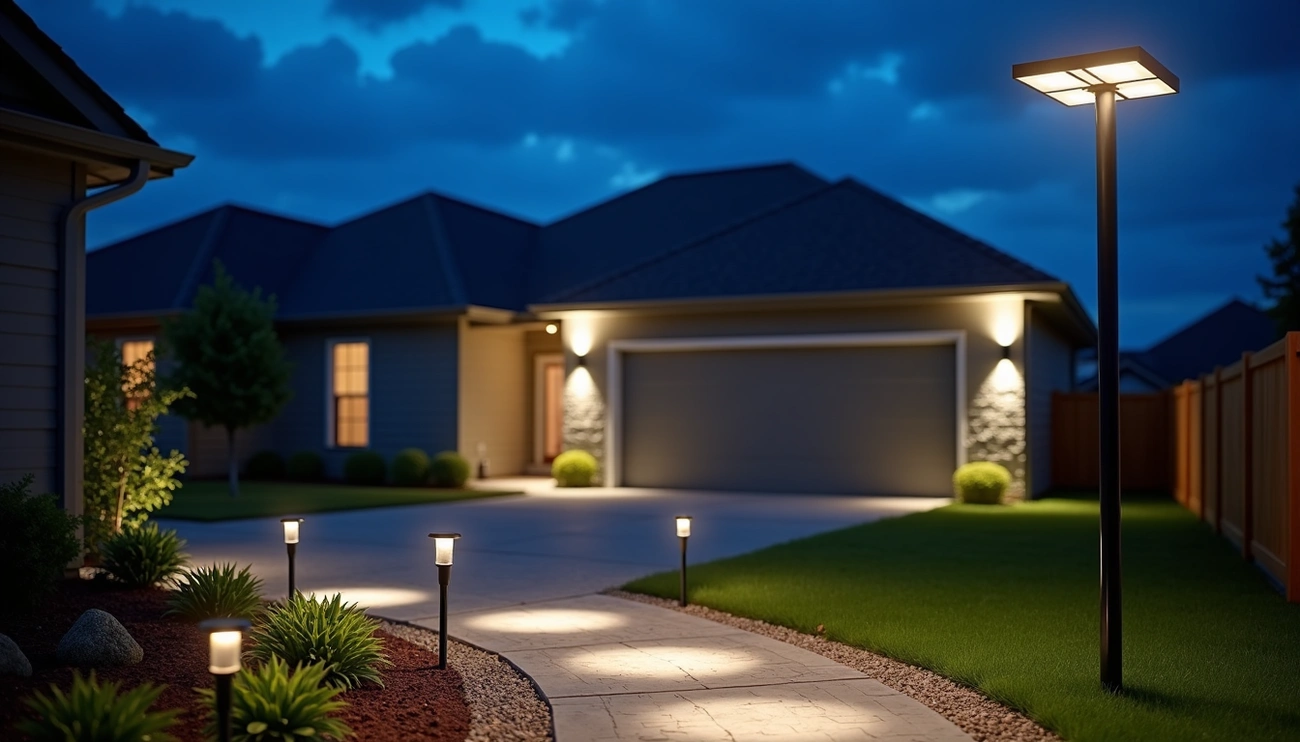
The highest lumens for solar lights typically range from 1,000 to 3,000+ lumens for residential security lighting. Commercial solar lights can exceed 10,000 to 44,000+ lumens for large areas such as parking lots. Popular residential models include 1,000–1,600 lumen motion lights and 3,000-lumen multi-head floodlights.
What is the highest lumens for solar lights?
Understanding lumen ranges in solar lighting
Solar lighting technology has progressed to where we can produce outputs that compete with traditional grid-powered fixtures. The spectrum spans from decorative garden accents at 50-200 lumens to massive infrastructure projects pushing beyond standard expectations.
At the lower end, pathway lights operate between 100-300 lumens, providing enough illumination to guide footsteps without creating harsh glare. Security applications typically demand 700-2,000 lumens to eliminate hiding spots around entry points and driveways. Spotlights used for landscape features generally fall between 100-1,200 lumens, concentrating their output through narrow beam angles.
The middle tier covers most residential needs. Post lights in residential settings usually sit at 100-400 lumens, while more powerful fixtures reach 3,000-5,000 lumens for comprehensive coverage. A 4,000-lumen output provides daylight-level visibility across large backyards, making it effective for both security and functional lighting needs.
Residential vs. commercial lumen outputs
Residential solar lights max out around 3,000-5,000 lumens, balancing brightness against battery capacity constraints. This range handles everything from subtle pathway illumination to serious security floodlighting. Small-scale residential installations typically use 100-1,000 lumens, sufficient for gentle patio or sidewalk lighting.
Commercial applications demand significantly more power. High-performance commercial solar lights start at 5,000 lumens and extend to 20,000+ lumens for high-traffic zones. Parking lots, public parks, and commercial perimeters typically require 12,000-22,200 lumens to maintain consistent, broad illumination across large areas.
Main roads need 4,000-10,000 lumens to ensure driver visibility and safety. Commercial spaces like parking lots and plazas operate best with 5,000-12,000 lumens. The gap between residential and commercial outputs reflects different safety requirements, coverage areas, and operational demands.
Specialized high-lumen solar applications
The absolute peak for solar lighting reaches 40,000 lumens[2] in specialized commercial projects. These massive solar street or floodlights serve expansive areas like highways or industrial complexes where visibility cannot be compromised. Similarly, large outdoor areas such as parking lots can be equipped with fixtures emitting 7,400-20,000 lumens.
Some manufacturers offer systems capable of doubling up poles to achieve 44,400 lumens, though these installations require substantial solar panels and battery banks. Standard commercial-grade parking lot fixtures typically deliver 7,400-22,200 lumens with 20-year service lives.
Residential streets and paths use medium outputs of 2,000-5,000 lumens, providing comfortable illumination without excessive glare for neighbors. For specialized applications, all-in-one solar units are available with outputs of 6,000, 12,000, and 20,000 lumens, incorporating intelligent night modes and motion sensing to extend battery runtime.
The practical ceiling for most applications sits well below the theoretical maximum. High-lumen systems demand larger solar panels, heavier batteries, and more complex installation. These factors raise costs and installation complexity, making ultra-high outputs practical only when truly necessary for safety or operational requirements.
How to measure and understand brightness in solar lights
What are lumens and why they matter
Lumens quantify the total amount of visible light a source emits. In essence, they tell you how much light comes out of a fixture in all directions. A lamp rated at 800 lumens emits twice as much light as one rated at 400 lumens, regardless of how that light gets distributed across your space.
The Federal Trade Commission requires all manufacturers to include lumen information on their packaging. This standardization helps you compare different solar lights accurately. For solar lighting specifically, lumens directly indicate how well a fixture will illuminate your space without overburdening your energy system.
When selecting the highest lumen solar lights, focusing on lumens rather than other metrics ensures you get actual brightness. A traditional 60-watt incandescent bulb produces around 800 lumens. Modern LED technology achieves the same brightness with only 8-12 watts, demonstrating why lumens serve as the true measure of brightness.
The difference between lumens and lux
Lumens measure total light output from a fixture, while lux measures how much of that light actually lands on a surface. Think of lumens as the total amount of water flowing from a hose. Lux represents how wet a specific spot on the ground gets.
A 1,000-lumen lamp lighting a 1 square meter table produces 1,000 lux. That same lamp spread over 10 square meters drops to 100 lux. Lux accounts for both light quantity and distribution across space.
Distance plays a critical role in lux measurements. The closer you position yourself to a light source, the higher the lux reading. As you move away, light disperses and lux decreases. When evaluating lux ratings, always check the specified distance. Without knowing measurement distance, you cannot make valid comparisons between fixtures.
Lumens vs. watts: clearing up the confusion
Watts measure power consumption, not brightness. This distinction matters enormously for solar applications where you work with stored sunlight in batteries. A 60-watt incandescent bulb produces about 800 lumens with an efficiency of 13.34 lumens per watt. A 15-watt CFL generates the same 800 lumens at 53.34 lumens per watt. An LED bulb delivers identical brightness using only 10 watts, achieving 80 lumens per watt.
Modern LED technology has advanced substantially. By 2024, LEDs reached 200 lumens per watt efficiency. The Philips LUXEON 3030 2D Mid Power LED achieves 209 lumens per watt. This luminous efficacy, expressed as lumens per watt, measures how efficiently a light source converts energy into visible light.
Higher luminous efficacy means more light for less energy. Two different solar lights might both consume 5 watts, but one could emit 500 lumens while another produces 800 lumens. The difference comes down to LED chip efficiency and design quality.
How beam angle affects perceived brightness
Beam angle determines how light spreads across an area, directly affecting perceived brightness. A narrow beam angle under 30 degrees concentrates light for focused applications like spotlighting garden features. Wider beam angles exceeding 60 degrees work better for general illumination along pathways.
Light distribution impacts effectiveness regardless of total lumen output. A fixture with high lumens but poor beam control can feel weak in large spaces if light spreads too thinly. Conversely, a smaller lamp with focused distribution proves very effective in compact areas. For pathway lighting, wider beam angles ensure even coverage. For dramatic highlighting effects, narrower angles create concentrated illumination where you need it most.
Factors that determine lumen output in solar lights
Several technical components work together to determine how many lumens your solar lights can actually produce. Understanding these factors helps you identify quality systems and set realistic expectations for performance.
LED chip efficiency and performance
The LED chip serves as the foundation for light output. High-quality LEDs produce more light while consuming less energy, which matters enormously when working with limited solar-generated power. Premium chips like the BXCD45 from Bridgelux achieve efficiency ratings around 160-170 lumens per watt.
However, this efficiency doesn’t transfer directly to your outdoor space. When the chip gets combined into a complete bulb, efficiency drops approximately 15% to 20% due to factors like beam angle design, chip assembly, and power supply components. In other words, that 160-170 lm/W chip efficiency becomes 130-140 lm/W at the bulb level.
The losses continue when you assemble the bulb into the lamp housing. Secondary optical lenses and housing angles reduce efficiency another 6% to 10%, bringing final output down to 120-130 lm/W. For instance, Philips’ LUMILEDS 3030/5050 chips maintain 170 lm/W efficiency with lifespans reaching 50,000 hours, demonstrating why chip quality impacts long-term performance.
Solar panel power and battery capacity
The solar panel captures sunlight and converts it into electrical energy, directly impacting brightness. A more efficient panel charges the battery faster and more completely, resulting in brighter light output. Monocrystalline panels typically outperform polycrystalline alternatives in energy conversion.
Battery capacity determines both brightness intensity and duration. Larger capacity batteries store more energy, enabling brighter illumination or extended operating hours. The chemistry matters equally. Lithium-ion batteries offer higher energy densities and longer lifespans compared to nickel-metal hydride or lead-acid alternatives. Modern lithium-ion systems also provide superior performance on cloudy days.
Battery charge level and light output
Battery capacity controls how bright the light shines and how long it stays on. Bigger batteries help maintain steady output, preventing the dimming that occurs halfway through the night with undersized systems. As batteries degrade over time, you’ll notice capacity fade where the battery holds less energy, coupled with power fade where it cannot deliver energy as quickly.
Solar controller type and its impact
The solar controller manages energy flow between the panel, battery, and LED. Different controller types affect charging efficiency and battery health, though the impact on immediate lumen output remains indirect. Smart controllers can adjust output based on real-time conditions, extending battery life while maintaining desired brightness levels throughout the night.
Matching lumen requirements to different outdoor areas
Selecting the right lumen output depends entirely on what you’re lighting and why. Each outdoor space has distinct requirements based on visibility needs, safety concerns, and ambient light levels.
Pathway and garden lighting needs (100-300 lumens)
Path lights work best in the 100-200 lumen range for walkways and garden paths, ensuring safety without excessive glare. This output level guides footsteps effectively while maintaining a welcoming atmosphere. Step lighting requires even less, typically 12-100 lumens to illuminate stairs and elevation changes.
For landscape features, you’ll need 50-300 lumens depending on what you’re highlighting[163]. Small plants and flower beds shine with 20-100 lumens, creating soft ambient glow. Medium shrubs and small trees need 100-300 lumens for proper definition. Wall-mounted accent lights typically operate at 100-250 lumens. Pool areas require 200-400 lumens for safe nighttime swimming[163].
Bollards offer flexibility across settings. Residential walkways perform well with 120-700 lumens, while commercial and retail installations benefit from outputs exceeding 700 lumens.
Security and driveway lighting (700-2000 lumens)
Security applications demand substantially brighter output. Motion sensor lights typically range from 300-700+ lumens, activating upon detecting movement to enhance safety[162][163]. For general outdoor security use, aim for at least 700-1000 lumens.
Residential driveways need 300-700 lumens for adequate visibility, though typical installations use 1,200-1,400 lumens to cover the entire area safely. Garage areas benefit from 1,200-2,000 lumens given their size and the need to detect movement from distance. Flood lights designed for wide area coverage deliver 700-1,300 lumens[162].
Small porches and entryways function well with 400-800 lumens, while large driveways or backyards require 2,000 lumens or more. Backyards and property perimeters vary widely, demanding anywhere from 1,000-3,000+ lumens depending on size and complexity.
Large area and commercial applications (3000+ lumens)
Commercial parking lots need upwards of 1,500 lumens per fixture to ensure safety and security. Expansive backyards requiring intense illumination benefit from 2,000+ lumens. For vast commercial properties, consider 4,000-10,000 lumens overall or more as required.
Motion sensor lights and adjustable brightness
Motion-activated systems conserve energy by remaining off until movement triggers them. Fixtures equipped with motion sensors can increase brightness when detecting activity, providing enhanced security. Adjustable settings let you customize output based on environment, choosing lower settings for ambiance and higher for safety.
How to choose the right high-lumen solar lights
Choosing the right outdoor solar lights highest lumens involves more than picking the brightest number on the box. Several practical factors determine whether a fixture will perform reliably in your specific environment.
Evaluating your space and lighting goals
Start by assessing sunlight exposure across your property. Solar lights need at least six hours of direct sunlight daily for optimal performance. Walk your space at different times to identify which areas receive consistent sun versus those shaded by mid-afternoon. Consider your lighting purpose as well. Security requires clear visibility around entry points, whereas garden paths benefit from softer illumination.
Battery capacity for sustained brightness
A massive 20,000mAh battery capacity enables sustained high-brightness operation. Larger batteries store extra energy, allowing lights to shine longer during rainy or cloudy periods. Lithium-ion batteries outperform nickel-metal hydride alternatives, offering higher energy densities and lasting 3-5 years under optimal conditions. Battery specifications should align with your desired brightness and duration requirements.
Weather resistance and durability features
Check IP ratings to ensure durability. IP65 indicates dust-tight protection against water jets from any direction. For harsh conditions, IP67 provides resistance to water immersion. High-quality materials like corrosion-resistant aluminum or stainless steel extend lifespan.
Color temperature options for different purposes
Color temperature, measured in Kelvin, affects both function and ambiance. Warm white (2700K-3000K) creates cozy atmospheres for patios and gardens. Cool white (5000K-6500K) enhances visibility for security applications. Natural white (4000K-4500K) provides balanced illumination for pathways.
Installation placement for maximum performance
Face solar panels toward the south in the northern hemisphere for maximum energy collection. If south-facing placement isn’t possible, east or west orientations work acceptably. Consider remote solar panels with long cables between the panel and light, allowing placement optimization. Mount security lights high to cover larger areas while positioning motion detectors appropriately.
Balancing brightness with battery life
Dimming capability changes everything when managing the highest lumen solar lights. Adjustable brightness settings let you customize output, extending battery life at lower settings. Motion sensors conserve energy by activating full brightness only when detecting movement.
Conclusion
Solar lights have come a long way, with outputs ranging from subtle 50-lumen accents to powerful 40,000-lumen commercial systems. For this reason, your choice should always start with understanding your specific space and purpose rather than simply chasing the highest number available.
Residential applications rarely need more than 3,000-5,000 lumens, while pathways work perfectly at 100-300 lumens. Focus on lumens rather than watts when comparing options, and consider factors like battery capacity, LED efficiency, and weather resistance.
When you match brightness to actual needs, you’ll get better performance and longer battery life. Choose wisely, and your solar lights will deliver reliable illumination for years.