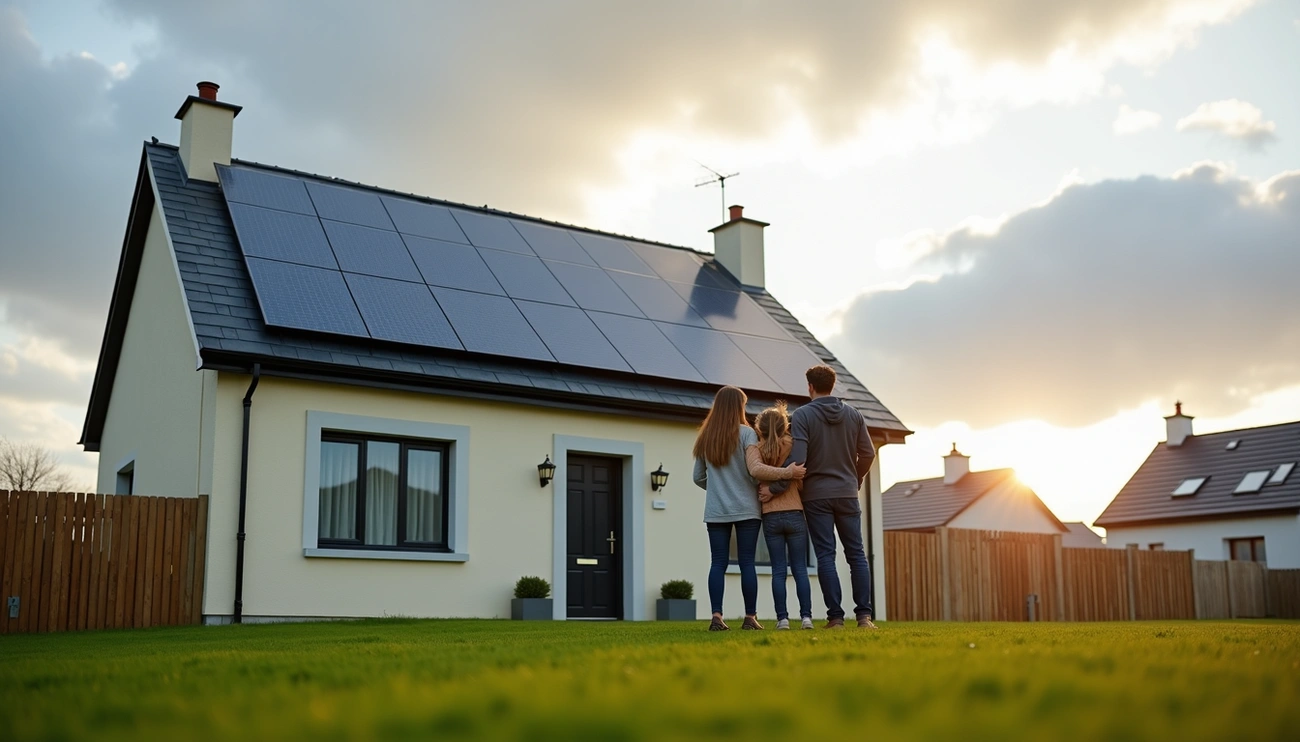
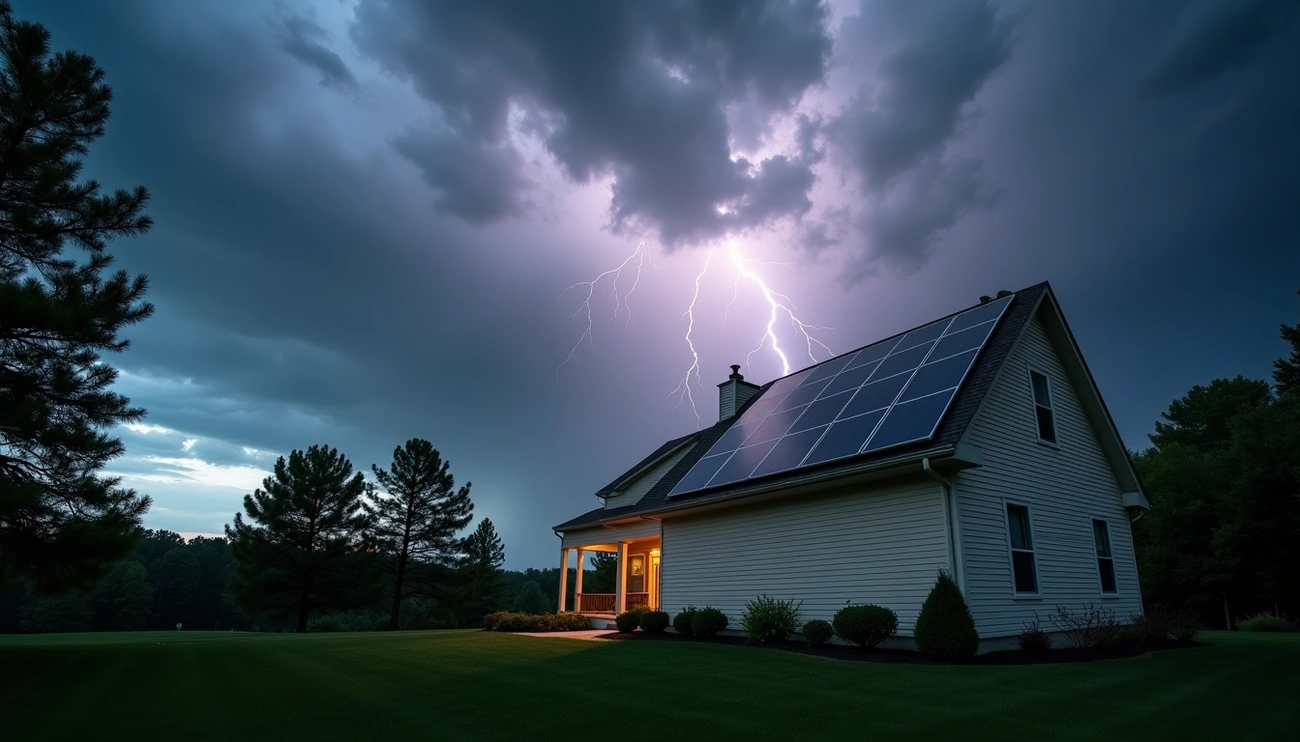
Solar panels do not attract lightning because they do not create the atmospheric charge or static electricity required to draw a strike. Lightning strikes depend mainly on an object’s height, location, and surrounding terrain. Although solar panels contain metal components, they do not increase a home’s lightning risk, but a direct strike can still damage the system.
Do Solar Panels Attract Lightning?
How Lightning Actually Works
Lightning forms through a process of electrical charge separation within storm clouds. Negative charges gather near the base of the cloud, while positive charges build at the top. This separation creates electric fields between the cloud and ground, setting the stage for a strike.
When conditions are right, a channel of negative charges called a stepped leader moves toward the ground in steps of about 50 to 100 meters in length. At the same time, positive charges on the ground concentrate on elevated objects and send upward streamers to meet the descending leader. When these two connect, usually between 30 to 100 meters above the ground, the actual lightning we see occurs. This is the return stroke, a luminous electric current that shoots up to the cloud, heating the air to temperatures of about 30,000°C (54,000°F). The entire process happens in less than one second.
What many don’t realize is that most lightning strikes are negative strikes, accounting for about 95% of cloud-to-ground strikes. In the U.S., lightning strikes about 25 million times per year.
Why Solar Panels Don’t Attract Lightning
Solar panels do not increase the risk of lightning strikes. Lightning seeks the highest point in an area, not metal objects specifically. The electric field is strongest on grounded objects whose tops are closest to the base of the thundercloud, such as trees and tall buildings.
Since solar panels add only a few inches to your roof height, they do not meaningfully increase your building’s lightning-attraction profile. Your building’s elevation relative to surrounding structures, nearby trees, and geographical features determines lightning risk far more than the presence of solar panels. If your solar panel is the tallest object in the area, it can get hit, but it doesn’t specifically attract lightning.
The Role of Metal and Conductivity
The common myth that metal attracts lightning has been thoroughly debunked by meteorological science. Metal itself does not attract lightning from a distance. While metal is an excellent conductor of electricity, it doesn’t have a magnetic pull on lightning.
Lightning seeks the path of least resistance to ground, not specifically metal objects. In fact, conductivity only matters once lightning has already chosen its strike point based on height and location. Metal provides a preferred pathway if it’s already part of the shortest route for the strike, but it doesn’t draw lightning toward it. Construction materials play a secondary role compared to height and location.
What Actually Attracts Lightning
Building Height and Structure
Height stands as the single most dominant factor in determining lightning strike probability. Taller structures extend closer to the storm clouds above, effectively shortening the path for the electrical discharge. The Empire State Building gets struck nearly 100 times a year, demonstrating how height dramatically increases exposure.
Buildings above 60 meters face an additional risk. Lightning can strike not just the top but also the side elevations, particularly at points, corners, and edges. When a structure reaches higher into the atmosphere, it becomes more likely to produce the upward streamers that connect with the descending stepped leader.
Pointed or peaked structures concentrate electrical charges more effectively than flat surfaces. A house with a sharply pitched roof will attract strikes before an identical home with a flat roof at the same elevation. The sharp angles create weak spots where charges accumulate, making connection with the lightning channel more probable.
Geographic Location and Terrain
Where you live matters significantly. Florida experiences the highest frequency of cloud-to-ground lightning in the United States, with the Tampa to Orlando corridor seeing the most activity. Sea breezes from the Atlantic Ocean and Gulf of Mexico converge over solar-heated land, lifting moist air masses that generate frequent thunderstorms.
Lightning occurs more often over land than ocean because solid earth absorbs sunlight and heats up faster than water. This creates stronger convection and greater atmospheric instability. Correspondingly, areas near the equator see more lightning than polar regions, where snow and ice-covered surfaces don’t warm effectively.
Mountains and hilltops get struck frequently because they offer the shortest path between cloud base and ground. Elevated terrain naturally positions objects closer to the electrical activity overhead.
Proximity to Tall Objects
Isolated structures face substantially higher risk than buildings surrounded by other objects of similar height. A warehouse standing alone in an open field has no nearby competition to share the lightning exposure. The strike will target that single prominent feature.
Dense clusters of buildings or trees distribute the risk. When multiple tall objects exist in close proximity, any one of them might produce the connecting streamer. Isolation removes this protective effect.
Open Fields vs Protected Areas
Standing in an open field makes you the tallest object, dramatically increasing strike risk. Research comparing different environments found that a wide flat field reduces risk to 53% compared to taking no precautions, while a large dense forest reduces it to 48%. The difference between these environments is minimal statistically.
Dense forests prevent direct strikes to people because tall trees intercept the lightning first. However, forests introduce other hazards. Side flash can travel about 3 meters through air from the struck tree, potentially reaching anyone nearby.
What Happens If Lightning Hits a Solar Panel
Lightning remains the number one cause of catastrophic failures of solar installations. Understanding what happens when lightning strikes helps you assess risks and prepare adequate protection measures.
Direct Strike Damage
Direct strikes occur when lightning physically contacts solar panels or mounting structures. While relatively rare, the consequences are severe. The current can reach 100 kA with a 10/350 µs waveform, generating enough energy to melt panels and inverters instantly. These strikes often cause complete system failure, with repairs requiring expensive replacements or entire system overhauls.
Indirect Strike and Power Surges
Indirect strikes pose a far greater threat because they happen more frequently. When lightning hits within several miles of your installation, it induces voltages exceeding 10,000 volts in solar system wiring. A real-world example from Florida in 2023 demonstrates this risk: a strike 800 feet away induced a 4,000-volt surge that destroyed the string inverter, monitoring equipment, and damaged three panels, with total damage exceeding $8,000. Indeed, good surge protection can stop up to 95% of lightning damage.
Impact on System Efficiency
Damaged cells convert sunlight less effectively, leading to reduced energy production. Power output degrades exponentially with lightning impulse voltages, and components experience premature aging that compromises long-term performance.
Physical Damage to Components
Lightning produces broken panels, burnt wires, melted parts, and dangerous sparking that could ignite combustible materials. The intense heat can crack panel surfaces and destroy photovoltaic cells.
How to Protect Solar Panels from Lightning
Protecting your solar installation from lightning damage requires multiple defense layers working together. While you cannot prevent strikes, you can minimize their impact through proper system design.
Proper Grounding Systems
All equipment must bond to one single earth ground. If components connect to separate grounds, voltage differences during nearby strikes can cause arcing between equipment. A single ground rod rarely provides adequate protection. In arid climates with dry soil, you may need as many as a dozen rods to achieve 10 ohms ground resistance, which is accepted as optimum (25 ohms is the NEC minimum). Space multiple 8-foot ground rods at least 6 feet apart, connecting them with bare copper wire.
Installing Surge Protectors
Surge protection devices act as clamps, conducting when voltage exceeds safe levels and shorting excess voltage to ground. Install DC surge arrestors on charge controller inputs and AC surge arrestors on both inverter input and output sides. Most inverter damage originates from AC side surges through house or generator wiring. Spending over $200 on quality surge arrestors beats repair bills exceeding $100,000 for lightning-damaged inverters.
Using Lightning Arrestors
Lightning rods provide additional protection in high-activity areas. Mounted above your array, they attract strikes and channel energy safely to ground through down conductors.
Regular Maintenance and Inspections
Inspect your system periodically for loose wires, corrosion, and wear, particularly after storms. Lightning protection systems can fall through maintenance cracks despite their importance.
What to Do After a Lightning Strike
Disconnect your system if safe. Inspect for burned, melted, or cracked panels, wires, and connections. Test voltages and check all components including inverters, charge controllers, and batteries. Contact professionals if major damage exists.
Conclusion
Solar panels don’t attract lightning any more than your regular roof does. Above all, height and geography determine strike risk, not the presence of solar equipment. While we can’t prevent lightning entirely, we can protect our investment through proper grounding, quality surge protection, and regular maintenance. These protective measures reduce damage risk by up to 95%, making them worthwhile investments. By and large, a well-protected solar system will serve you reliably for decades, even in lightning-prone areas.