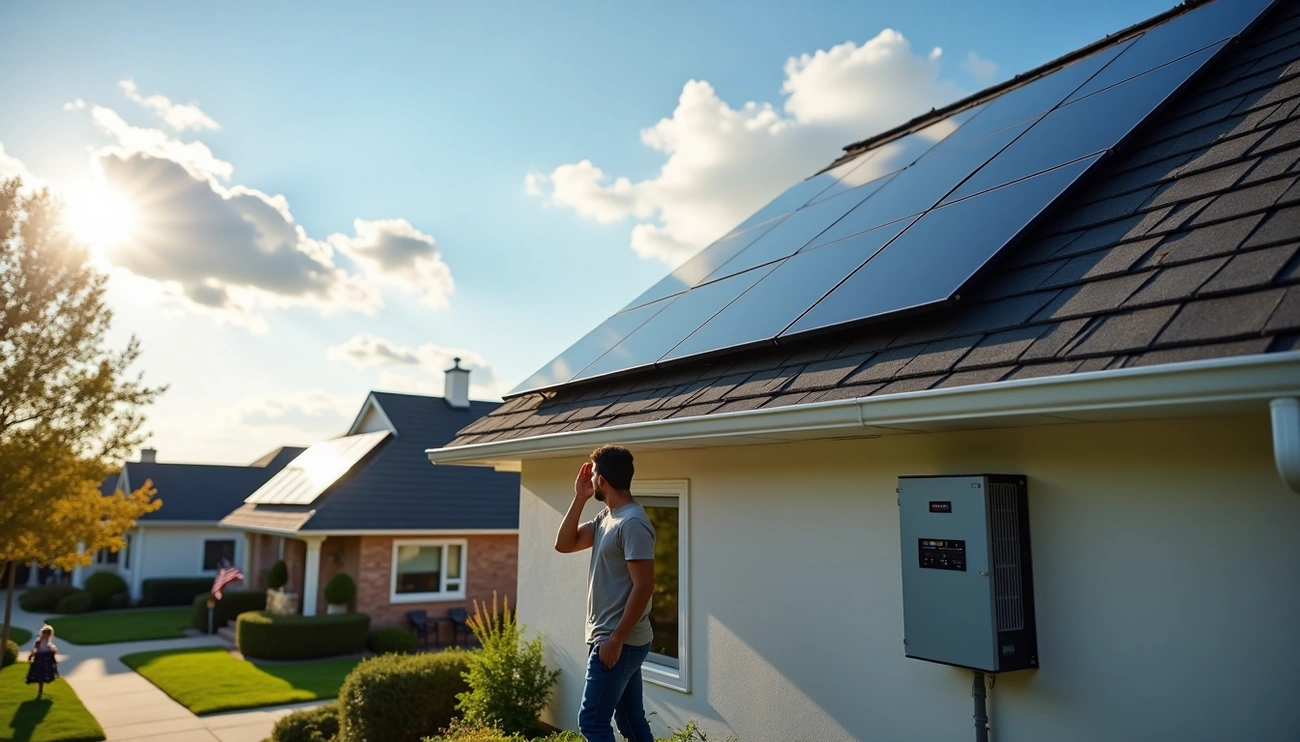
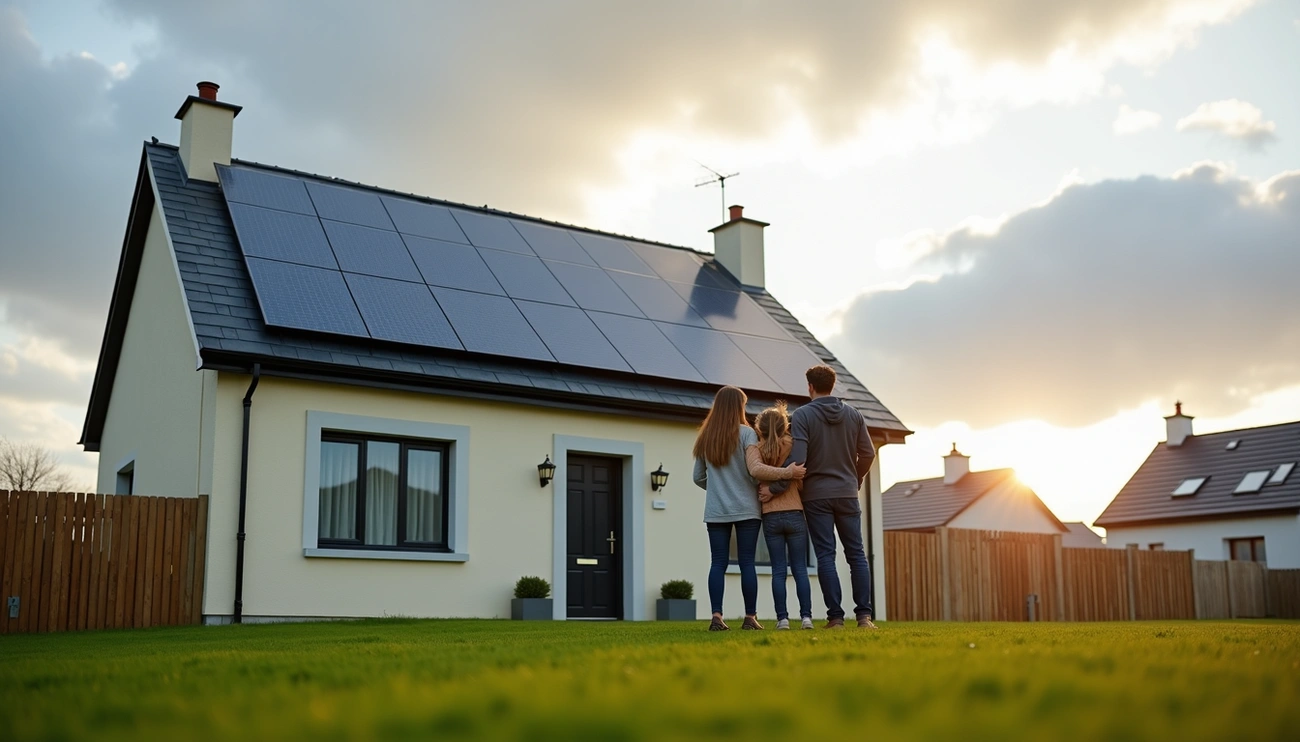
Solar panels are worth it in Ireland because high electricity prices and government incentives reduce payback time to about 5–8 years. Grants up to €1,800 and 0% VAT lower installation costs. A typical solar system supplies 60–70% of a home’s electricity, cuts energy bills, and allows homeowners to sell excess power back to the grid.
The Real Cost of Solar Panels in Ireland
Typical installation costs for Irish homes
The average cost for a solar PV system in Ireland sits between €7,000 and €10,000 after applying government grants. Without grants, expect to pay anywhere from €8,000 to €15,000 for a complete installation. This wide range depends on several factors that directly impact your final bill.
System size drives the biggest cost variation. A standard domestic setup costs around €1,500 to €2,000 per kW installed. Your energy consumption patterns matter too. Families using more electricity need larger systems, which naturally cost more upfront but generate better returns.
Roof characteristics play a surprising role in pricing. An awkwardly shaped roof extends installation time from two days to three, adding labor costs. Location affects pricing as well. Installers traveling longer distances charge more to cover their time and expenses.
The quality of panels and equipment creates another cost divide. Premium brands command higher prices but deliver better efficiency and longer warranties. Solar panels typically come with 25+ year warranties, while inverters last 5-15 years.
How government grants reduce your upfront investment
The SEAI Solar PV grant cuts your investment significantly. You’ll receive €700 per kWp up to 2kWp, then €200 for each additional kWp up to 4kWp. The maximum grant caps at €1,800 in 2026.
Here’s how the grant structure works: a 1 kWp system gets €700, a 2 kWp system receives €1,400, a 3 kWp system qualifies for €1,600, and a 4 kWp system reaches the maximum €1,800.
In addition to the grant, the government introduced a 0% VAT rate on solar panel supply and installation for private residences in May 2023. This replaced the previous 13.5% rate, removing thousands of euros from installation costs.
Once approved, you have eight months to complete installation and submit your Declaration of Works. The grant expires after this period, so timing matters.
Price breakdown by home size
Different homes require different system sizes, which correspondingly affects total costs:
A 3.5kWp system with eight panels costs €7,350 initially, dropping to €5,650 after the €1,700 SEAI grant. This setup generates roughly 3,000 kWh annually and saves around €846 per year.
For a 4.4kWp system with ten panels, the initial cost reaches €8,100, reduced to €6,300 with the €1,800 grant. Annual generation hits 3,700 kWh with savings of approximately €1,043.
Larger homes with a 5.5kWp system (twelve panels) pay €8,900 upfront, or €7,100 after grants. These systems produce 4,500 kWh yearly and save around €1,269 annually.
The biggest residential systems at 7kWp (sixteen panels) cost €10,000 before grants, €8,200 after. They generate up to 6,100 kWh per year and save approximately €1,720 on electricity bills.
Hidden costs to consider
Beyond panels and installation, several additional expenses catch homeowners off guard. Battery storage adds €1,700 to €3,000 to your total cost. A power diverter for your immersion heater runs €300 to €650.
Inverter replacement becomes necessary every 10-15 years at €500 to €1,500. Some homes need roof reinforcement or electrical system upgrades to support solar panels. Maintenance costs between €100 and €300 every one to two years keep your system running efficiently.
You’ll also need a post-installation BER assessment before receiving your grant payment. Factor in these costs when calculating whether solar panels are a good investment for your situation.
Do Solar Panels Work in Ireland’s Weather?
Why cloudy days don’t stop solar generation
Solar panels don’t need blazing sunshine to function. They capture diffuse light, which is sunlight scattered through cloud cover. Think of getting sunburned on an overcast beach day. UV rays penetrate clouds, and the same principle applies to the photons your solar panels need.
On a typical overcast day in Ireland, your panels still generate anywhere from 10% to 50% of their sunny day output. Modern photovoltaic cells convert daylight into electricity using semiconductor materials, not heat. This means panels work whenever there’s daylight, regardless of cloud thickness.
Rain actually benefits your system. Water washes away dust and pollen, maintaining panel efficiency. Cooler temperatures improve performance too, since extreme heat reduces output. Ireland’s moderate climate creates ideal operating conditions year-round.
Ireland’s actual sunshine hours vs expectations
Ireland receives between 1,100 and 1,600 sunshine hours annually depending on location. Met Éireann data shows the sunniest months are May and June, averaging 5 to 6.5 hours of sunshine daily across most counties. December drops to roughly 1 to 2 hours daily in the darkest regions.
These numbers might seem low compared to Mediterranean countries, but they’re sufficient for strong solar returns. Germany and the UK lead Europe in solar adoption despite similar sunshine levels. Broad studies across Ireland show typical annual generation values between 880 and 1,000 kWh per kWp installed, averaging around 960 kWh/kWp.
Performance data from real Irish installations
Real-world results exceed expectations. A 3kW system in Galway generated 3,071 kWh in 2019, surpassing the software estimate of 2,455 kWh. A 6kWp system in Wexford with east-west orientation produced 4,560 kWh annually, despite not having optimal south-facing placement.
Over 60,000 homes across Ireland now have solar panels installed. A standard home solar PV system generates around 40% of an average Irish household’s annual electricity demand. These installations continue operating effectively regardless of weather patterns, proving the technology works in Irish conditions.
Location impact: Best and worst counties for solar
Geography creates performance variations, but differences remain smaller than most expect. Wexford leads with 965 kWh per kWp annually, sitting 9.2% above the national average. Waterford produces 949 kWh (7.4% above average), while Wicklow generates 947 kWh (7.1% above average).
Western and northern counties produce slightly less. Donegal generates 817 kWh per kWp, which sits 7.6% below the national average. Mayo and Sligo also rank in the lower range at 841 kWh and 847 kWh respectively.
The southeast receives more direct sunlight and longer daylight hours throughout the year. Coastal areas record more sunshine than inland regions due to cloud formation patterns over land. Even in the lowest-performing counties, solar delivers positive financial returns when professionally installed.
Solar Panels ROI: When You’ll Break Even
Average payback period in Ireland (5-7 years)
Your solar investment pays for itself between 6 and 8 years across most installations. The consistency holds true whether you’re looking at industry calculations or real homeowner data. A standard residential system averages around 7.4 years to break even.
Geography affects this timeline more than you might expect. In Wexford, where sunshine hours peak, a 4kWp system generating 3,761 kWh annually creates €1,147 in combined savings and export income, resulting in a 5.58-year payback. Compare that to Sligo, where 3,049 kWh generation produces €929 annually, extending payback to 6.88 years. That’s a 1.3-year difference purely based on location.
System size matters too. An 8-panel setup takes 8 years and 3 months to recoup costs, whereas a 16-panel system breaks even in just 5 years and 4 months. Larger systems generate proportionally better returns because fixed costs get spread across more panels.
Once you hit that break-even point, the panels keep producing for another 18 years under warranty. Over a full 25-year lifespan, cumulative savings exceed €24,000 for typical installations, with larger systems pushing well beyond that figure.
Annual electricity savings you can expect
The primary financial benefit comes from self-consumption. Basically, every kWh your panels generate that you use immediately saves you from paying the current retail rate of €0.35 to €0.43 per kWh. This avoided cost drives your returns far more than export payments.
A typical 4kWp system produces around 3,890 kWh annually in Dublin. Assuming 50% self-consumption, you’ll use 1,945 kWh directly, saving €836 at current rates. Most homeowners report monthly savings of €91 on electricity bills, which compounds to over €1,000 yearly for well-optimized systems.
How feed-in tariffs boost your returns
The remaining 50% of your generation gets exported to the grid through the Clean Export Guarantee scheme. Suppliers pay between 15 and 25 cents per kWh for this exported electricity. Pinergy currently offers the highest rate at 25c per kWh, whereas Energia pays 18.5c and Electric Ireland provides 19.5c.
These rates fluctuate as suppliers compete for customers, so shopping around matters. Exporting 1,945 kWh annually at €0.20 per kWh generates €389 in additional income, pushing total annual returns to €1,225.
Selling excess power back to the grid
The export process runs automatically once you complete an NC6 form with ESB Networks. Your smart meter tracks every 30-minute interval, measuring exactly how much power flows back to the grid. Credits appear on your electricity bill rather than as direct payments.
The first €400 of export income remains tax-free each year through 2028. Given that most residential systems export between €150 and €400 annually, you’ll likely pay zero tax on these earnings.
SEAI Grants and Financial Support Available
Solar PV grant amounts and eligibility
Government backing reduces your installation costs through the SEAI Solar PV Scheme. The grant pays €700 per kWp for the first 2kWp installed, then €200 for each additional kWp up to 4kWp. This caps at €1,800 for systems of 4kWp or larger.
Your property must have been built and occupied before December 31, 2020 to qualify. Apply through SEAI’s online portal before starting any work. Once approved, you have 8 months to complete installation and submit all required documentation. Miss this deadline and your grant expires.
The installer must appear on SEAI’s registered contractor list. After installation, a registered BER assessor evaluates your home before SEAI releases payment. Processing takes 4 to 6 weeks once you submit final paperwork.
0% VAT on solar panel installation
Since May 1, 2023, solar panel supply and installation carries a 0% VAT rate for private dwellings. This replaced the previous 13.5% rate, cutting roughly €1,000 from average installations.
The zero rate applies only when the same company supplies and installs your panels in a single contract. Buying panels separately and hiring an installer afterwards reverts to standard VAT. Houses, apartments, duplexes, and even immobilized mobile homes qualify. Commercial buildings, farm structures, hotels, and B&Bs remain ineligible.
Battery storage, wiring, controllers, and labor all qualify for 0% VAT when bundled with panel installation. EV chargers stay at 13.5% VAT even when installed alongside solar.
Clean Export Guarantee scheme
The CEG allows you to sell surplus electricity back to the grid. Suppliers pay between 18 and 25 cents per kWh for exported power. Pinergy currently offers 25c per kWh, while Electric Ireland pays 19.5c.
You’ll need a smart meter for accurate export tracking. Without one, suppliers calculate payments using a deemed export formula based on your system capacity. Register with your electricity supplier to start receiving payments, which appear as monthly credits on your bill.
Tax-free income from microgeneration
Export income up to €400 annually remains exempt from income tax, USC, and PRSI through December 31, 2028. The exemption applies per named individual on your electricity bill, not per household. Dual-income households potentially earn up to €800 tax-free by having both partners listed.
Once you exceed €400 in export income, you must declare the excess amount. Given that most residential systems export between €150 and €400 annually, tax liability rarely becomes an issue.
Should You Add Battery Storage to Your System?
How batteries maximize solar panel benefits
Battery storage transforms how you use solar electricity. Without storage, an average Irish home consumes 65% to 70% of generated power directly, with the remainder exported to the grid. Adding a battery pushes self-consumption to 85% to 90%, keeping more energy in your home rather than selling it at lower export rates.
Batteries charge when panels generate surplus electricity during daylight hours. Later, when the sun sets and panels stop producing, stored energy powers your home instead of drawing from the grid at retail rates. In addition, batteries can charge overnight using cheaper night-rate electricity, which you then use during expensive daytime hours.
Cost vs value of adding battery storage
A 5kWh battery adds €1,700 to €2,200 to your installation cost. An 8kWh system delivers approximately €360 in annual savings through combined solar storage and night-rate storage, creating a 7-year payback period. About two-thirds of Irish customers choose battery storage when installing solar panels.
When battery storage makes sense for your home
Batteries deliver greatest value when you’re away during peak solar generation hours. Empty homes waste daytime production by exporting at low rates, whereas batteries store that energy for evening use. If your household occupies the home during daylight, using solar power directly often makes more sense financially.
Temperature affects battery performance. Optimal operation occurs between 14°C and 22°C, making indoor installation preferable over uninsulated attics or outdoor locations.
Conclusion
Solar panels are absolutely worth it for Irish homeowners, without doubt. We’ve shown that cloudy weather doesn’t stop generation, government grants slash upfront costs significantly, and most systems pay for themselves within 6-7 years. Annual savings of €1,000 or more make a compelling case, regardless of your county.
The 60,000 Irish homes already enjoying these benefits prove the technology works here. Before choosing an installer, compare quotes from at least three SEAI-registered contractors and verify their references. Calculate your specific payback period based on your electricity usage and roof orientation. Once you’ve done your research, solar panels represent one of the smartest home improvements you can make.