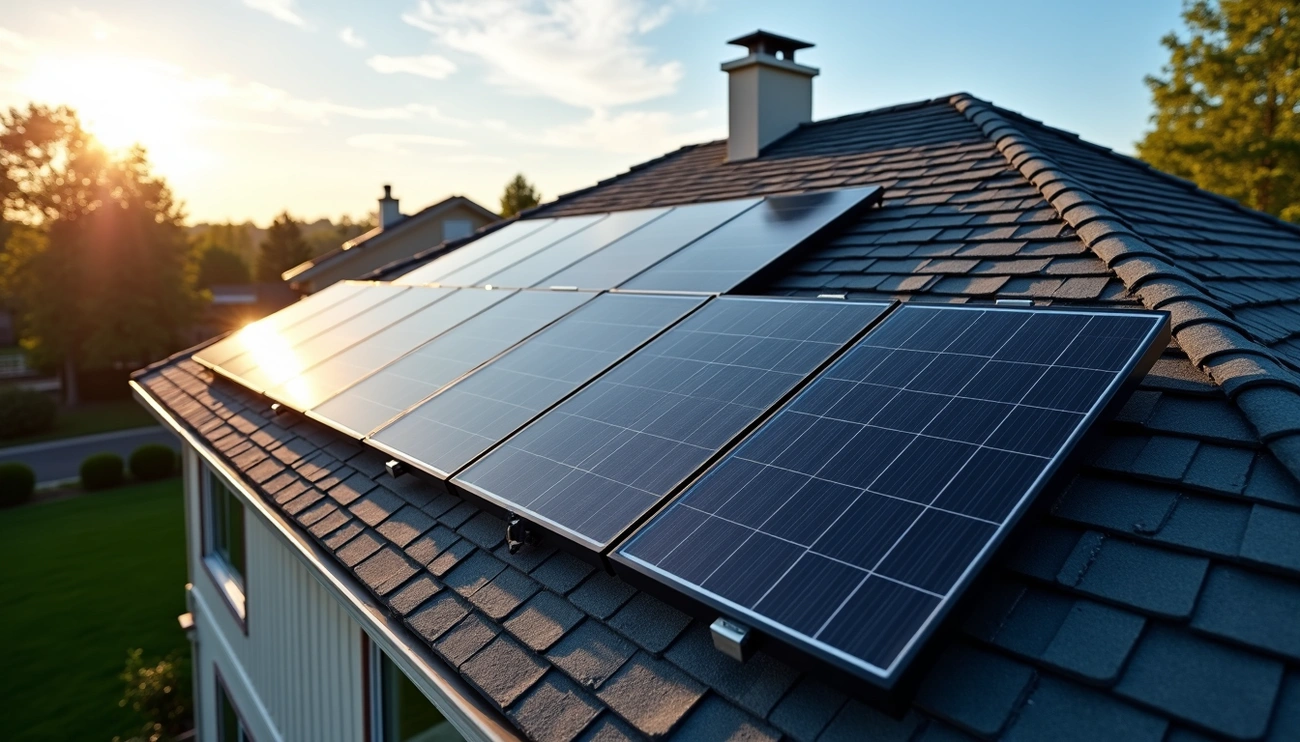
Hyundai solar panels are good quality solar panels known for durability and efficient performance. Hyundai panels reach efficiency rates around 20.5%–20.6% and use advanced N-type TOPCon or shingled cell technology. Hyundai is a Tier 1 bankable manufacturer and offers product and performance warranties ranging from 25 to 30 years.
Why Hyundai solar panels stand out
Hyundai’s reputation in solar starts with a foundation few manufacturers can match. The company traces its roots back to 1972, when Hyundai Heavy Industries established itself as one of the most trusted names in heavy industries. With a Fortune 500 designation and over 48,000 employees, the parent organization generates substantial annual revenue that reached $40.9 billion in 2015. This financial backing matters when you’re making a 25-year investment in solar panels.
Corporate stability and backing
HD Hyundai Group operates across seven business divisions, bringing the kind of corporate stability that ensures your warranty will be honored decades from now. The solar division started as a core business unit before spinning off as an independent company in December 2016. Despite this independence, Hyundai Solar maintains its connection to the larger HD Hyundai ecosystem, which provides both financial resources and technical expertise from related energy infrastructure companies.
The company’s commitment to renewable energy goes beyond token gestures. HD Hyundai has invested heavily in developing what it calls a “future growth engine” in the clean energy sector. For homeowners evaluating whether hyundai solar panels are any good, this long-term corporate commitment reduces the risk of dealing with a manufacturer that might exit the market.
Quality manufacturing standards
Hyundai operates as South Korea’s largest and longest-standing PV cell and module manufacturer. Production capacity has grown from 600 MW to 800 MW, and recent data shows the company now maintains 1.4 GW of annual production capacity. This scale allows for consistent quality control and economies that benefit pricing.
The company invests more than $20 million in innovative technologies through its R&D laboratory. In other words, product development receives substantial funding rather than relying on incremental improvements. Recent advances include N-type TOPCon modules with efficiency ratings between 22.3% and 22.9%, plus development work on HJT and tandem cells for next-generation products.
Notably, Hyundai holds a TOPCon license that eliminates intellectual property risks when exporting cells produced in Korea to the U.S. market. This gives the company flexibility other manufacturers lack when navigating trade regulations.
Global market presence
Hyundai serves more than 3,000 customers across multiple continents. The company sells panels in Europe, the United States, Australia, and throughout Asia. Recent contract wins demonstrate this reach. In 2025, Hyundai secured a 36 MW supply agreement with U.S.-based Turning Point Energy. Earlier projects include the massive LUCY Project in Texas, a 455 MWdc solar installation covering an area equivalent to 1,600 soccer fields.
These large-scale deployments provide real-world performance data that residential customers benefit from. When a company successfully delivers utility-scale projects, the same quality standards flow down to residential product lines.
Testing and certifications
Hyundai’s R&D center holds accredited test laboratory status from both UL and VDE. This means the company can conduct its own testing rather than relying solely on third-party facilities. Products meet IEC 61215 and IEC 61730 standards certified by VDE, plus UL 1703 listing with Type 1 Class A fire rating.
The panels pass advanced mechanical testing at 5,400 Pa (IEC) and 40 lbs/ft² (UL). Environmental resistance includes IEC 62716 ammonia corrosion testing and IEC 61701 salt mist corrosion standards. Potential-induced degradation testing at 85°C and 85% humidity for 600 hours confirms long-term reliability. Quality certifications include ISO 9001:2000, ISO 14001:2004, and OHSAS 18001:2007.
Hyundai backs its products with warranties that have evolved to 30 years for both product defects and performance guarantees. This extended coverage reflects confidence in manufacturing quality and provides protection that matches or exceeds industry standards.
Understanding Hyundai solar panel options
Choosing between Hyundai’s product lines means understanding what each series delivers and where it performs best. The company manufactures 13 distinct series with 55 different models, spanning power outputs from 290W to 595W. For residential installations, four main series dominate the market.
Residential panel series overview
The XG Series represents Hyundai’s standard residential offering. These panels use half-cut monocrystalline cells with multi-busbar technology. Power output ranges from 350W to 375W, with efficiency ratings between 19.2% and 20.6%. The all-black design eliminates visible grid lines, which matters if esthetics influence your decision.
YH Series panels take a different approach with bifacial technology. These modules feature 132 half-cut cells and produce between 385W and 410W. Efficiency sits slightly lower at 19.3% to 20.5%[51]. The panels measure 1,038mm wide by 1,924mm long and weigh approximately 21.1kg.
UF Series panels push efficiency higher through shingled cell construction. Maximum efficiency reaches 21.3%, making this Hyundai’s most efficient residential option. Power ratings span 375W to 400W using 360 cells arranged in 10 strings of 36. The compact design measures just 1,646mm in height.
VG Series panels also employ shingled cells but use larger 166mm cells compared to the UF’s 158.75mm format[71]. This results in 340 cells configured as 10 strings of 34 cells. Output ranges from 385W to 410W with efficiency between 19.9% and 20.7%.
Power ratings from 350W to 410W
The 60-watt difference between entry-level XG panels and top-tier YH models translates to meaningful production variations. A 350W panel produces roughly 15% less electricity than a 410W unit under identical conditions. For a typical 20-panel residential system, this gap represents about 1,200W of total capacity.
Temperature coefficients also vary. XG Series panels lose 0.36% of power per degree Celsius above 25°C. YH Series performs marginally better at -0.347%/°C[51]. In hot climates, these small differences compound over thousands of operating hours.
Bifacial vs standard panels
Bifacial panels capture sunlight from both front and rear surfaces[43]. The YH Series can generate 5% to 25% additional power from reflected light, depending on installation conditions. A system producing 400W from the front face might add 20W to 100W from the rear, bringing total output to 420W-500W.
Standard monofacial panels like the XG Series only collect light from the front surface. This works fine for rooftop installations where the panel’s backside faces your roof with no reflective benefit. Bifacial technology delivers minimal advantage in this scenario.
Best applications for each model
XG Series panels suit traditional rooftop installations where space isn’t severely constrained. The moderate efficiency and lower cost make sense when you have adequate roof area.
YH Series bifacial panels shine in ground-mounted residential or small commercial systems. Reflective surfaces beneath the array boost performance. Snow-covered ground, white gravel, or light-colored concrete surfaces increase rear-side energy capture substantially.
UF Series makes sense when roof space runs tight. The 21.3% efficiency squeezes maximum production from limited areas. Premium pricing typically accompanies this performance advantage.
VG Series offers a middle ground with shingled cell efficiency and compatibility with more panels per string due to lower voltage. This flexibility helps match panels to specific inverter configurations.
Performance metrics that matter
Three numbers determine whether hyundai solar panels are any good for your specific installation: efficiency percentage, temperature coefficient, and shade tolerance. Each metric reveals how panels convert sunlight and handle real-world conditions.
Efficiency ratings explained
Efficiency measures what percentage of sunlight hitting your panels converts into usable electricity. Hyundai’s residential panels achieve efficiency ratings between 19.2% and 20.6%, which sits right at the market average of around 19%. Some models push higher. The NF(BK) Series reaches up to 22.53% efficiency, converting nearly a quarter of incoming sunlight into power.
These percentages matter more than they initially appear. A panel at 20.5% efficiency produces roughly 7% more electricity than one at 19.2% from the same roof area. For homeowners with limited space, specifically those dealing with small or partially shaded roofs, higher efficiency ratings squeeze more production from available square footage.
Hyundai achieves these numbers through PERC technology, where cells reflect sunlight back into themselves for additional conversion. The shingled cell format used in UF and VG series panels reduces resistance and power loss by approximately 75% compared to traditional designs.
How temperature affects output
Solar panels produce less energy as they heat up. The temperature coefficient quantifies this loss. Hyundai panels range from -0.35% to -0.42% per degree Celsius, falling within the typical industry range of -0.3% to -0.5%. The YH series performs particularly well at -0.347%/°C.
Here’s what this means in practice. At 25°C (77°F), a 400W panel produces its rated output. When temperature climbs to 35°C (95°F), a panel with -0.4%/°C loses 4% of its power, dropping to 384W. In hot climates where panels regularly reach 65°C, you’re looking at approximately 360W output.
Shade tolerance and reliability
Shingled panels handle shading 40% better than standard designs. The reason comes down to cell connections. Traditional panels connect cells in series, so one shaded cell reduces current through the entire string. Shingled cells connect in parallel, meaning shaded cells don’t drag down their neighbors.
Half-cut cell construction provides additional benefits. The 132-cell design in YH series panels reduces operating temperature and lowers hotspot formation risk. With lower current flowing through each cell, resistive losses decrease while reliability improves.
Cost analysis and value proposition
Pricing solar panels involves more than sticker shock. Regional variations, installer markups, and available rebates create a wide cost spectrum that makes exact estimates difficult.
Investment breakdown
Most Hyundai systems fall between $2.50 and $3.56 per watt. A 6 kW installation runs $15,000 to $21,360 before incentives. After applying the 30% federal tax credit, that same system drops to $10,500 to $14,952. Larger 8 kW systems range from $19,000 to $28,000 depending on model selection and installer.
Panel-only pricing sits around $0.80 to $1.00 per watt before installation labor and equipment. In view of complete system requirements, you’ll add inverters, mounting hardware, permits, and labor. These additional components typically account for 30-40% of total project costs.
Average-sized installations land in the medium price bracket at $26,600 to $33,300 before tax credits, or $18,600 to $23,300 after federal incentives. For panels delivering 19.6% to 20.6% efficiency with 25-year warranties, this positions Hyundai as cost-effective.
Comparison to average solar costs
National average solar costs hit approximately $3.03 per watt as of January 2025. Hyundai’s $2.50 to $3.56 range straddles this benchmark. Some sources place typical U.S. residential costs between $2.71 and $3.31 per watt, confirming Hyundai occupies the middle territory.
Hyundai panels deliver above-average power and efficiency without premium pricing. The VG series, for instance, produces 385W to 410W while maintaining costs at or below market averages. You won’t pay extra for performance that matches or exceeds standard offerings.
Long-term savings potential
Payback periods average 10 years for most U.S. homeowners. After breaking even, systems generate essentially free electricity for 15-20 additional years. Total savings over 25 years typically reach around $60,000.
Annual returns range from 10% to 15%, outperforming traditional stock market investments averaging 8-10%. Solar panel ROI calculations factor in eliminated utility bills, ongoing incentive payments, and electricity rate increases averaging 2-3% annually.
State and local incentives further improve returns. Cash rebates, performance payments, and property tax exemptions can reduce initial costs by 30-50% beyond federal credits. Net metering programs add value by crediting excess production at retail electricity rates.
Hyundai systems require minimal maintenance over their lifespan. Occasional cleaning and annual inspections represent the primary ongoing expenses, with inverter replacement after 10-15 years being the only significant future cost.
Are Hyundai solar panels any good? The verdict
Hyundai delivers solid value without requiring you to compromise on quality or performance. The panels work well for most residential installations, though specific advantages and limitations shape who benefits most.
Pros of choosing Hyundai
PERC design maintains production numbers during cloudy days and winter months. Shingled panels resist shading 40% better than standard designs. You get 25-year coverage on both product defects and performance. The shingled format creates a uniform appearance that looks cleaner than conventional panels.
Pricing sits at just over $1.00 per watt depending on your inverter system. Efficiency ranges from 19% to 20%, extracting more electricity per square foot than average panels. Tempered glass construction withstands harsh weather. The panels eliminate power loss from light-induced degradation.
Cons to consider
Supply chains limit availability in some U.S. markets. European and Australian customers access better warranty terms than American buyers. Residential options remain limited to a few series. Product warranties run shorter at 10-15 years compared to premium manufacturers.
Who should buy Hyundai panels
Value-minded homeowners find the sweet spot between cost and performance. Provided that you have adequate roof space, the moderate efficiency delivers sufficient production without premium pricing. The corporate backing from a Fortune 500 company ensures warranty support decades from now.
Alternatives to compare
Review multiple quotes with different equipment before committing. Compare efficiency ratings, warranty terms, and total system costs across manufacturers. Some alternatives offer higher efficiency or longer product warranties, while others cost less but deliver lower performance.
Conclusion
Hyundai solar panels deliver solid performance for most residential installations. With efficiency ratings between 19.6% and 20.6%, power outputs from 350W to 410W, and pricing that sits right at market average, you’re getting reliable panels without premium costs. The 25-year warranty and Fortune 500 corporate backing provide peace of mind that matters for long-term investments.
Before committing to Hyundai panels, compare quotes from multiple installers. Look at total system costs rather than panel prices alone. If you prioritize proven performance and financial stability over cutting-edge technology, Hyundai represents a smart middle-ground choice that balances quality with affordability.