
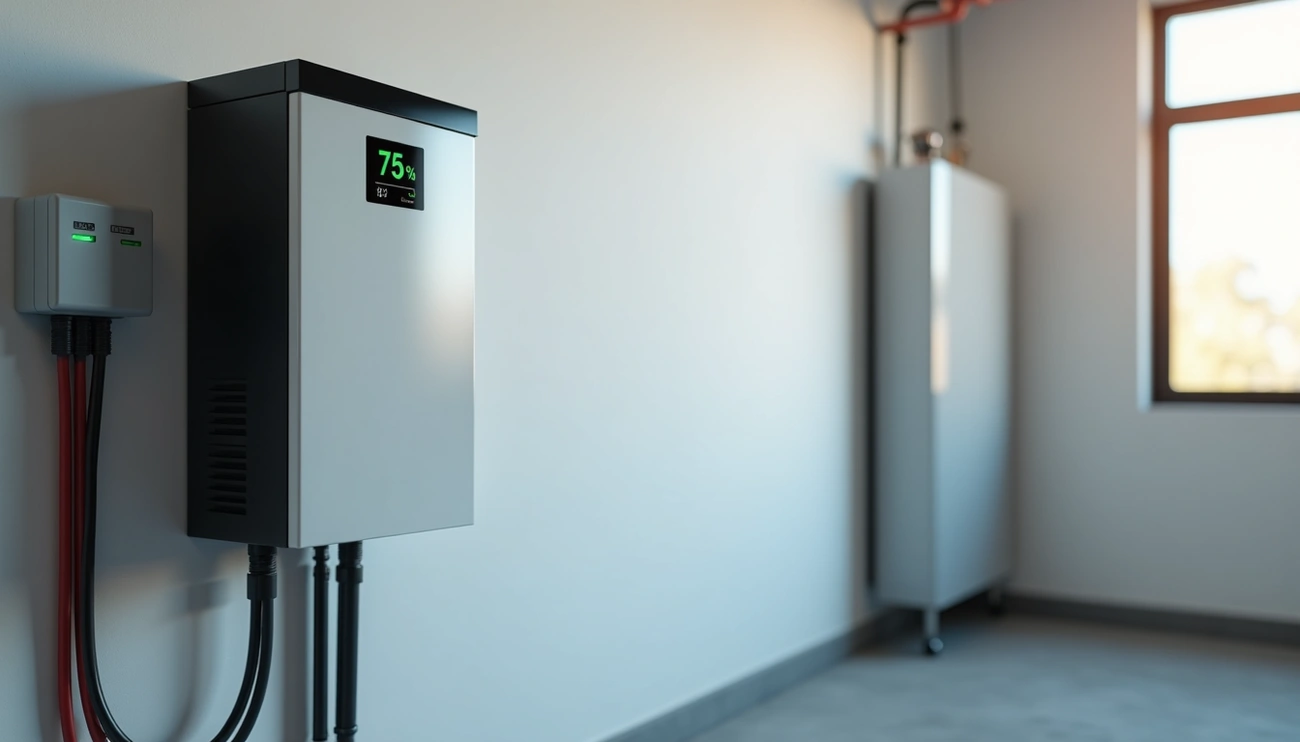
SOC in solar stands for State of Charge. State of Charge measures the percentage of energy stored in a battery compared to its total capacity, where 0% means empty and 100% means full. Solar systems use SOC to manage battery health, extend lifespan, and track available energy during nighttime or cloudy periods.
What Does SOC Stand For in Solar Systems?
SOC Battery Meaning Explained
SOC represents the remaining energy in your battery expressed as a percentage from 0% (empty) to 100% (full). Think of it as your battery’s fuel gage, but there’s an important distinction I need to clarify. A fuel gage measures a physical quantity like fuel volume, whereas battery SOC represents an inferred electrochemical state that cannot be directly observed inside the battery.
Here’s what that means for you: SOC readings are based on estimation methods, not direct measurements. Your system calculates SOC using voltage behavior, current tracking, or internal battery management electronics. This explains why your SOC display might occasionally behave unexpectedly, shutting down earlier than expected or continuing to operate even after reaching 0%.
I often see people confuse SOC with State of Health (SOH). SOC answers “How full is the battery right now?” while SOH answers “How much capacity does this battery still have compared to when it was new?”. SOC is an immediate measurement, whereas SOH considers long-term degradation.
How SOC is Displayed on Your System
Your battery SOC appears in different formats depending on your setup. Most modern solar batteries display SOC percentages directly on LCD screens or through dedicated mobile apps where you can monitor charge levels remotely. For instance, if you see “75% SOC” on your display, your battery has consumed 0.5kWh of its 2kWh capacity.
Some PWM controllers show SOC in the bottom left corner of the display. However, there’s a critical detail: SOC mode only works correctly when all your loads connect to the additional terminals on the controller. If only four terminals are in use instead of six, the controller operates in the wrong mode and will undercharge your battery.
SOC vs DoD (Depth of Discharge)
DoD and SOC are two sides of the same coin. They always add up to 100%. If your battery shows 30% SOC, your DoD is 70%. The calculation is straightforward: DoD = 100% – SOC.
For instance, if you have a 100 amp-hour battery and use 20 amp-hours, your DoD is 20% and your SOC is 80%. Discharge that same battery 70% and your SOC drops to 30%. Understanding this relationship helps you manage charging cycles effectively and maintain battery health.
How is Battery SOC Measured and Calculated?
Your battery management system uses several methods to calculate SOC, each with distinct trade-offs between accuracy and complexity.
Coulomb Counting Method
Coulomb counting tracks charge flowing in and out of your battery by integrating current over time. The formula is straightforward: SOC = SOC(t0) + 1/Crated ∫ Ibatt, where Crated is your battery’s nominal capacity in ampere-hours and Ibatt is the battery current. This method offers low implementation complexity and acceptable accuracy, but it comes with significant drawbacks.
The main problem surfaces over longer periods as estimated SOC drifts away from the actual value due to self-discharge behavior. Current measurement noise introduces errors that accumulate with time. Moreover, the method is sensitive to initial SOC values and prone to error accumulation. Losses during charging and discharging, along with self-discharge, cause accumulating errors that require regular recalibration.
Open Circuit Voltage (OCV) Method
The OCV method establishes a relationship between your battery’s open-circuit voltage and SOC using pre-calibrated lookup tables[61]. When your battery is disconnected from any load and fully relaxed, the BMS measures voltage and references it against stored SOC values.
However, this method requires your battery to rest for extended periods to allow voltage stabilization, making it unsuitable for real-time tracking. OCV tests are time-consuming, typically requiring 2-3 hours of relaxation to obtain accurate readings. Temperature variations and battery aging also affect the OCV-SOC relationship.
Kalman Filter and Advanced Algorithms
Kalman filters provide higher accuracy by combining battery models with real-time voltage, current, and temperature measurements. The Extended Kalman Filter (EKF) linearizes nonlinear battery systems, while the Unscented Kalman Filter (UKF) uses σ points for better accuracy. The Adaptive Unscented Kalman Filter (AUKF) updates noise covariance adaptively, achieving estimation errors stable within 2% with convergence speeds less than 50 seconds.
Why Accurate SOC Measurement Matters
Accurate SOC estimation extends battery lifetime, maximizes pack capacity, enhances power-system reliability, and allows aggressive battery use within design limits. Precise estimation prevents unpredicted system interruptions and protects batteries from overcharging and over-discharging, which cause permanent internal damage.
Why SOC Matters for Your Solar Battery Performance
SOC tracking plays a foundational role in how your battery management system regulates energy flow and protects your investment.
Controls Charging and Discharging Cycles
Your battery management system monitors SOC to maintain balance between charging and discharging cycles. When solar panels generate excess power during the day, your system stores energy until reaching the configured upper SOC limit. At night, stored energy powers your loads until the battery reaches its minimum SOC threshold. For instance, if you set your minimum SOC at 60%, your system uses capacity between 60% and 100% for daily self-consumption, reserving the lower range for grid outages.
Prevents Overcharging and Deep Discharge
SOC monitoring prevents damage from extreme charge states. Overcharging pushes batteries beyond designed voltage cutoffs, stressing electrodes and electrolyte, which gradually wears down cathode structure and causes irreversible capacity loss. Repeated overcharge cycles can increase self-discharge rates, reducing usable run-time by 10-20% or more. Deep discharge below 20% creates similar strain, causing voltage sag under load and shrinking available capacity by 5-15%.
Optimizes Energy Usage and Costs
Accurate SOC data enables confident participation in energy markets and maximizes asset utilization. Operators can bid more aggressively when SOC reflects actual deliverable capacity rather than conservative estimates. This precision shifts operations from estimation to validated energy data.
Extends Battery Lifespan
Batteries maintained within optimal SOC ranges between 20% and 80% perform better and last longer than those frequently overcharged or deeply discharged. Operating within conservative SOC windows minimizes stress and significantly extends useful life. In fact, limiting discharge to 80% instead of 90% may extend cycle life by up to 40%.
Key Factors That Affect Your Battery’s SOC
Several environmental and operational variables influence your battery SOC readings and their accuracy.
Temperature and Weather Conditions
Temperature dramatically impacts battery SOC behavior. The ideal operating range sits between 59-77°F. Cold weather reduces available capacity by 20-30%, with fully charged batteries delivering only 50% power at 0°F. When temperatures drop from 25°C to -15°C, SOC decreases by approximately 23%. High temperatures accelerate degradation, cutting battery lifespan in half for every 15°F increase above ideal temperature. Vehicles in hot climates degrade 0.4% faster annually than those in mild climates.
Charge and Discharge Current Rates
High charge and discharge rates stress your battery and affect SOC accuracy. Fast charging generates excess heat and accelerates lithium plating, contributing to battery wear. High-rate operations increase internal losses beyond what simple amp-hour tracking predicts. Discharge rate variations require advanced algorithms for precise SOC estimation.
Battery Age and Degradation
As batteries age, their actual capacity declines. If SOC calculations use original capacity values, errors accumulate. The Surface Electrolyte Interphase layer grows thicker over time, binding lithium and reducing available capacity.
Battery Management System (BMS) Quality
BMS accuracy varies significantly. One European operator experienced SOC underestimation by up to 45%. Advanced cloud-based systems achieve SOC accuracy within 2%.
User Charging Habits
Keeping batteries between 20% and 80% prevents stress from extreme states. Vehicles spending over 80% of time at extreme SOC levels experience 2.0% annual degradation versus 1.4% for low exposure.
Conclusion
SOC is far more than a simple percentage on your battery display. With this in mind, accurate SOC monitoring protects your investment by preventing damaging charge extremes, optimizing energy usage, and extending battery lifespan. The methods I’ve outlined here show you exactly what affects your battery’s performance. Take the time to understand your system’s SOC behavior, maintain optimal charge ranges between 20% and 80%, and you’ll maximize both efficiency and longevity.