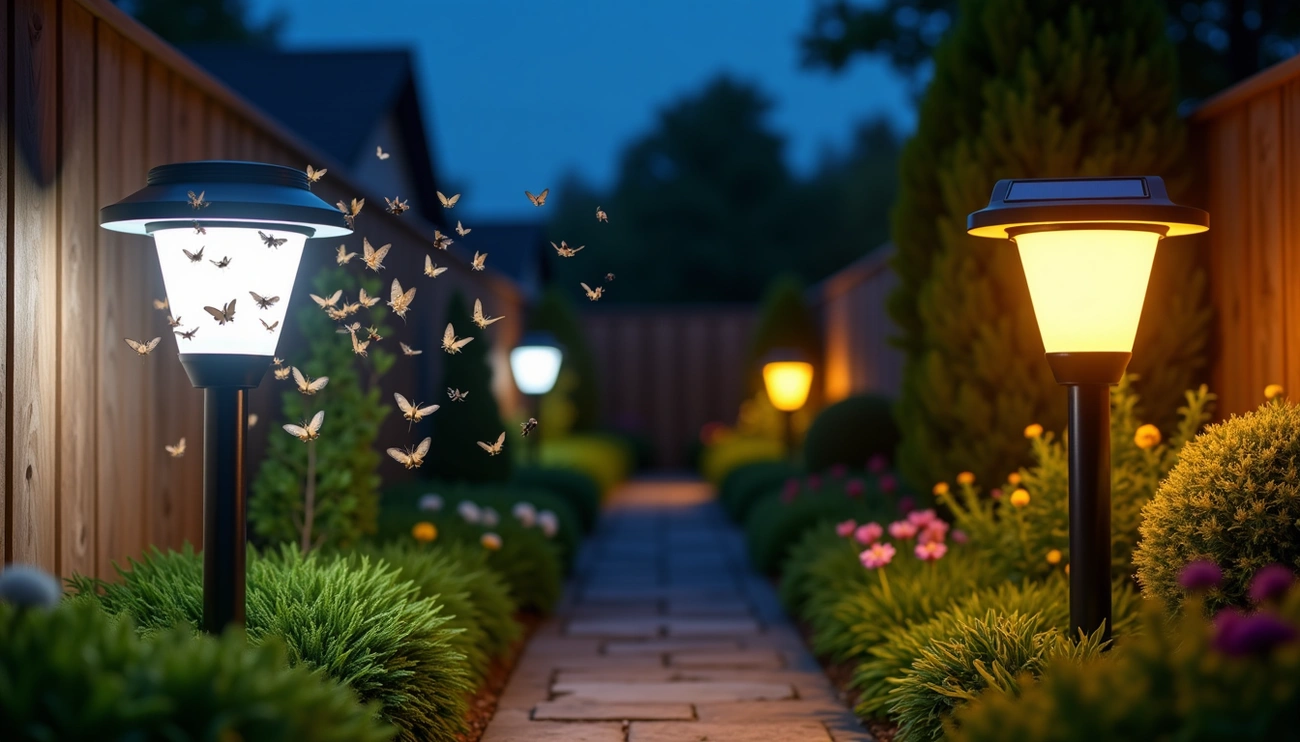
Solar lights attract fewer bugs than conventional lights because they usually emit lower-intensity, warmer-toned light that many insects cannot see easily. However, solar lights can still attract insects such as moths, beetles, and mosquitoes, especially when the light emits cool white or blue wavelengths that insects detect more strongly.
Do Solar Lights Attract Bugs? The Short Answer
Solar lights with warm colors attract fewer insects than traditional outdoor lighting options. The difference comes down to how these lights produce illumination and which wavelengths they emit.
How solar lights differ from traditional outdoor lighting
Traditional light sources like halogen, incandescent, and fluorescent bulbs produce light across a broad spectrum. This includes ultraviolet and infrared wavelengths that insects find irresistible. These bulbs also generate significant heat, which appeals to many insect species.
Modern solar outdoor lights tell a different story. They produce a much narrower spectrum of light, primarily in the visible range, and generate significantly less heat. Most solar lights use LEDs that emit light in different wavelengths. This fundamental difference means solar lights that don’t attract bugs are possible when you choose the right type.
The role of light wavelength in bug attraction
Insects don’t see the world like we do. Their vision is tuned to specific wavelengths, particularly shorter ones. Most bugs see best in the 300-400nm (UV) and 400-500nm (blue) ranges. Cool white LEDs with temperatures of 5000K or higher are basically a nightclub for bugs.
Research shows insects are generally more attracted to shorter wavelengths of light, particularly in the blue and ultraviolet spectrum. Blue light is highly visible to most insects, making fixtures with high blue content significant insect pollutants. In contrast, insects perceive yellow light in the 570-590 nanometer range, which is not where most flying insects see best.
Why warm-colored solar lights attract fewer insects
Bugs are less interested in warmer color temperatures. Lights with warm tones like yellow, amber, or warm white, typically in the 2700K-3000K range, attract fewer insects. Any light below 3300K has minimal impact on bug behavior. Warm white LEDs emit less UV light, making them less appealing to insects compared to cooler colors.
Yellow and amber LED lights attract far fewer insects than blue or white lights. Amber light, which has a longer wavelength and low blue/UV content, is far less attractive to insects. Red lights perform even better. Insects cannot see red wavelengths well, making red LED lights the best option for keeping bugs away. When you use red lighting, bugs almost cannot see your outdoor area.
Understanding Why Bugs Are Drawn to Light
The moon navigation theory
For decades, scientists believed insects used the moon as a navigation compass and mistook artificial lights for celestial bodies. Many nocturnal insects do utilize transverse orientation relative to the moon for navigation. However, a 2024 study revealed this theory doesn’t fully explain their bizarre behavior around artificial lights.
Researchers observed insects orbiting, stalling, and even flying inverted over lights. These patterns suggested something else was happening. The study found that insects aren’t actually attracted to light at all. Instead, artificial light disrupts their dorsal-light-response, which keeps their backs oriented toward the brightest part of the sky. When a bright artificial source appears, insects tilt their dorsal side away from the sky, causing them to fly in circles or attempt upside-down flight.
How insects perceive different light wavelengths
Insects possess opsin proteins in their photoreceptors that determine which wavelengths they can detect. These proteins are sensitive to wavelengths ranging from short ultraviolet to near-infrared. A single amino acid change in an opsin protein can alter what an insect sees. This sensitivity varies by species, with butterflies gathering nectar from red flowers while other insects respond to different color cues.
Heat-seeking behavior in mosquitoes and other insects
Mosquitoes use body heat to locate warm-blooded hosts for blood meals. Female mosquitoes detect heat through specialized coeloconic sensilla on their antennae, which contain thermosensory neurons. Attraction peaks near 40°C and declines above 45°C. Conduction and convection are the primary mediators of heat attraction at close range, not infrared radiation. Heat emission strongly promotes attraction and synergizes with carbon dioxide and visual cues.
The phototaxis effect explained
Phototaxis describes an organism’s innate movement toward or away from light. Most nocturnal flying insects exhibit positive phototaxis. Studies on fruit flies demonstrate this behavior is hardwired into their photoreceptors. When startled, flies move toward light sources, showing this innate preference for illumination.
Which Bugs and Wildlife Are Affected by Solar Lights
Different insect species respond uniquely to outdoor lighting, creating varied impacts across ecosystems.
Moths, flies, and beetles
Moths face severe consequences from artificial lights. Research shows 70% of moths flew towards streetlamps and away from flowering plants, reducing plant pollination. These nocturnal pollinators spiral toward light sources until they exhaust themselves, collide with hot surfaces, or fall prey to predators. Around 60% of insects active at dusk, night, and dawn are pollinators, including many nocturnal moths, beetles, flies, and bees. Consequently, moth populations have dropped by 30-40% globally in recent decades.
Beetles exhibit phototactic behavior, naturally drawn to light sources. June beetles are especially attracted to UV light and swarm around bright lights during evening hours.
Do solar lights attract mosquitoes at night
Mosquitoes don’t show particular attraction to ultraviolet or LED lights over standard lighting. In reality, artificial lighting potentially disorients them, acting as a deterrent rather than an attraction. LED lights emit less heat, making them even less appealing to mosquitoes, which don’t rely heavily on visual light cues for finding food sources.
Butterflies and bees
Monarch butterflies exposed to nocturnal light will flit and flutter when they should rest, appearing disoriented from their migration route the next day. Artificial lights disrupt circadian rhythms in many pollinators, leaving them unable to feed or mate effectively.
Impact on nocturnal animals like bats and owls
Bats show species-specific responses. Little brown bats avoided lights completely, with disturbance detected at least 75 meters away. Big brown bats decreased activity by 48-75% when lights were on. Bright security lights can stun bats, stopping them from hunting. Birds, especially owls, experience disrupted sleeping, mating, and hunting patterns.
How solar lights keep animals away from certain areas
Animals generally try to avoid solar lighting. This excess light affects breeding and feeding patterns, limiting available habitat for nocturnal species. Smaller animals like hedgehogs find their hibernation schedules disturbed.
How to Choose Solar Lights That Don’t Attract Bugs
Selecting the right solar lighting requires attention to specific features that minimize insect activity around your outdoor spaces.
Best light colors to minimize insect attraction
Amber and yellow lights in the 2000-2700K range cut insect visits by 60% or more. Research found that warm white LEDs in the 2700-3000K spectrum attracted the fewest insects, even fewer than dedicated yellow bug lights. For this purpose, stick with color temperatures below 3000K to avoid blue light emissions. Red lights offer the best performance since insects struggle to detect wavelengths in the 620-750nm range.
LED solar lights vs other bulb types
LEDs produce minimal heat and lower UV emissions compared to incandescent or halogen bulbs. Traditional incandescent bulbs generate significant heat and broad spectrum light, making them highly attractive to many species. Besides their energy efficiency, LEDs emit very little UV light, attracting fewer insects overall.
Proper placement and timing strategies
Install lights away from patios, doors, and seating areas. Even 10-15 feet of separation makes a huge difference. Position fixtures slightly elevated or angled downward to reduce direct light exposure. Downward-facing lights shine toward the ground rather than dispersing outward.
Using motion sensors and dimming features
Motion sensors limit active time, reducing the window for insects to gather. This approach significantly decreases overall attraction since lights on only when needed don’t give bugs time to establish presence.
Dark sky friendly solar lighting options
Dark sky compliant fixtures require maximum color temperatures of 3000K and fully shielded designs pointing downward. These fixtures minimize light pollution while reducing impact on nocturnal wildlife.
Conclusion
Solar lights don’t have to turn your outdoor space into an insect gathering spot. The key lies in choosing warm-colored LEDs with temperatures below 3000K, as shown above in our wavelength analysis. Amber, yellow, and red lights attract significantly fewer bugs than cool white options. By comparison, traditional bulbs create a bug magnet effect. I recommend selecting motion-activated, downward-facing fixtures with warm tones for the best results. Make smart choices, and you’ll enjoy bug-free evenings outdoors.