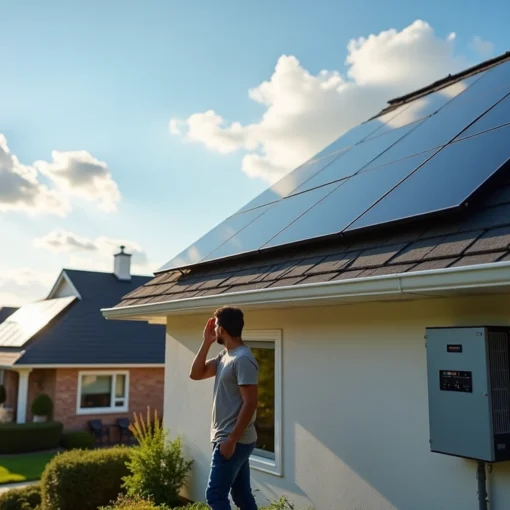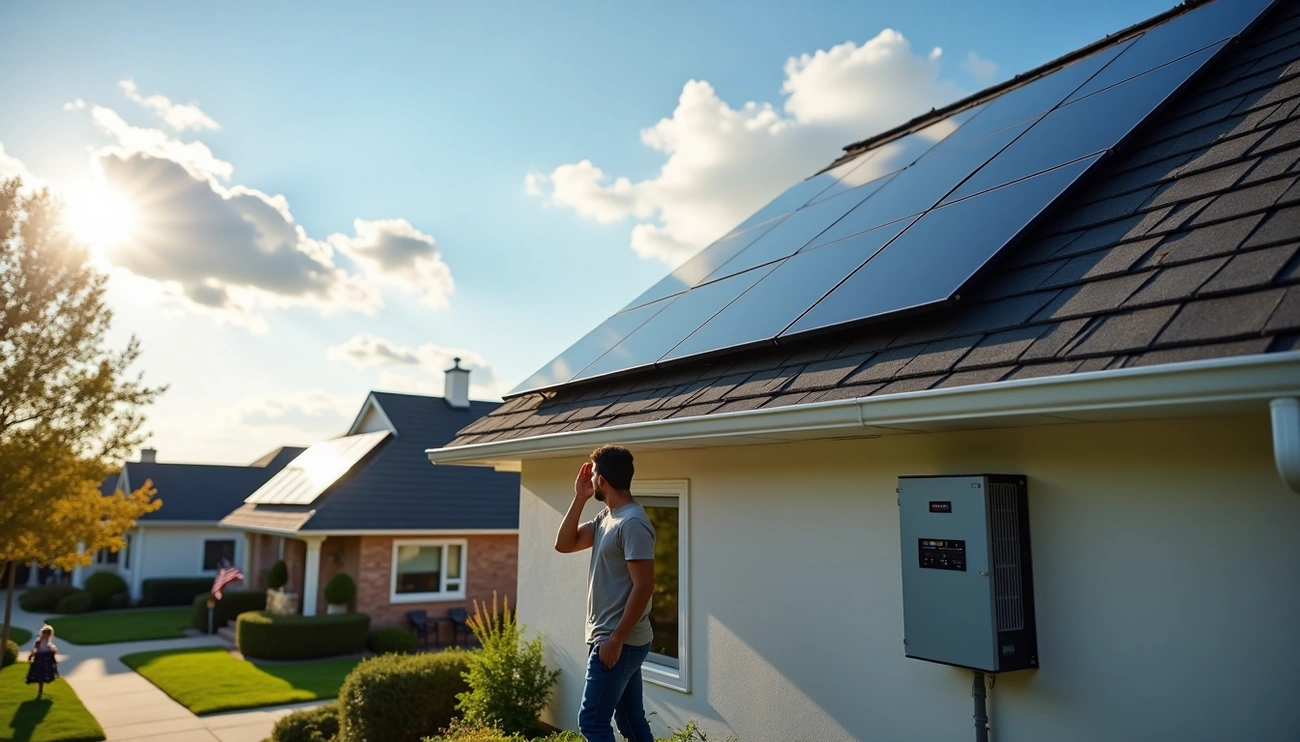
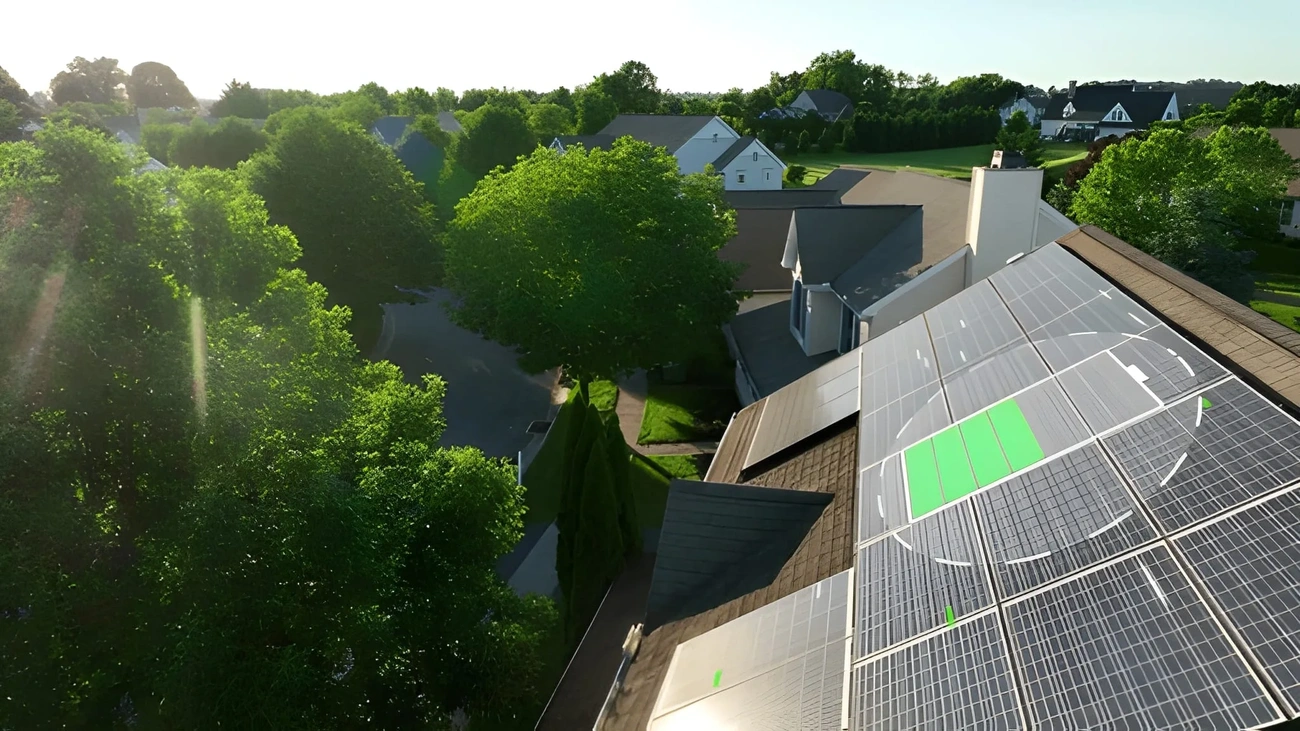
Standard grid-tied solar panels do not work during a power outage because the inverter automatically shuts down to protect utility workers and grid equipment. Solar panels only supply electricity during a blackout when the system includes a solar battery or an inverter with islanding capability that disconnects the home from the grid.
Why solar panels don’t work during a power outage
Grid-tied systems and safety requirements
Most residential solar installations connect directly to the utility grid through what’s called a grid-tied system. Your panels link to an inverter that converts solar energy into usable electricity, which then connects to your home’s main AC panel and a smart electric meter. This setup tracks both the energy you pull from the utility and any excess power your panels send back to the grid.
Grid-tied systems don’t include battery storage. They rely on the grid itself as your energy bank. When your panels produce more than you need, that surplus flows back to the utility. At night or during low production periods, the grid supplies your power needs.
Electrical safety codes mandate that these systems shut down during outages. The National Electric Code (NEC) 690.12 for Rapid Shutdown requires grid-tied PV systems to reduce DC voltage to safer levels within a short time window during emergencies. In practice, your inverter stops producing usable AC power when utility power drops out, specifically to avoid backfeeding electricity onto power lines where crews may be repairing damage.
The anti-islanding protection explained
Anti-islanding protection is the safety mechanism that forces your solar system offline during grid failures. An “island” refers to a dangerous situation where your solar installation continues feeding electricity into the grid during a widespread outage. This energizes power lines that utility workers expect to be dead, creating severe electrocution risks for those working to restore power.
Standards like IEEE 1547 and UL 1741 require all interconnected power sources to disconnect from the grid instantly and automatically during an outage. According to IEEE 1547 section 4, an Area EPS must be de-energized within two seconds of the formation of an island. Your inverter accomplishes this through continuous monitoring. It tracks voltage levels, frequency variations, and phase shifts. The moment these parameters drift beyond safe thresholds, the anti-islanding logic kicks in.
What happens to solar energy when the grid goes down
Sunlight still hits your panels during an outage. The photovoltaic effect continues, electrons still move, and your panels still produce DC voltage. But without a proper islanded circuit created by a battery system and compatible inverter, your inverter won’t convert that DC electricity into usable AC electricity for your outlets. The generated energy has nowhere to go, hence you won’t see your lights or appliances run from the panels.
How to use solar panels during power outage
Several solutions exist if you want your panels generating power when the grid fails. Each option addresses the anti-islanding shutdown problem differently, with varying costs and capabilities.
Solar battery backup systems
Battery storage captures excess solar production during normal operation and releases that energy during outages. When grid power drops, the system detects the interruption within milliseconds and automatically switches to battery power without manual intervention. You can designate specific circuits to receive backup power, prioritizing refrigerators, lights, medical devices, and communication equipment. The battery supplies electricity to these selected loads while non-essential circuits remain offline to extend runtime.
Off-grid solar systems
Off-grid installations operate independently from utility infrastructure. These systems combine solar panels with charge controllers and battery banks, creating a self-contained power source. You’re not subject to anti-islanding requirements since there’s no grid connection to protect. Off-grid setups require larger battery capacity and often include backup generators to supplement solar production during extended cloudy periods.
Hybrid inverters with backup capability
Hybrid inverters manage power flow between solar panels, batteries, and the grid simultaneously. The changeover from grid-tie to backup mode happens in less than 30 milliseconds for most models, though some take 10 to 60 seconds. Not all hybrid inverters can utilize solar power during backup mode. Some rely solely on stored battery energy, which limits runtime. Advanced models allow your panels to continue charging batteries during daylight hours while the grid stays offline, extending your backup duration indefinitely.
Portable solar generators
Portable solar generators pair battery packs with solar panels in compact, movable units. These aren’t designed to power entire homes but can support limited loads during short outages. They work well for temporary needs, remote locations, or supplemental emergency power when whole-house backup isn’t necessary.
How long will your solar system power your home
Runtime depends less on your battery’s label and more on what you choose to power. A 10 kWh battery can keep essential appliances running for approximately 24 hours, but that figure shifts dramatically based on your consumption choices.
Battery capacity and runtime factors
Battery capacity gets measured in kilowatt-hours (kWh), with most home systems storing between 10 and 20 kWh. A 13 kWh battery is fairly standard. Your battery’s runtime stems from the relationship between stored energy and active loads. For instance, if your evening consumption averages 500 to 800 watts with essentials only, a 15 kWh battery handles the night comfortably.
Duty-cycle loads dominate actual consumption. Your refrigerator might average 100 to 150 watts over a day, but peaks much higher when the compressor kicks on. Routers, lights, laptops, and phone chargers draw constantly but stay small. Silent power hogs include well pumps, space heaters, hair dryers, kettles, resistance water heaters, and older plasma TVs that drain batteries quickly.
Essential appliances vs. non-essential loads
Identifying priorities extends your backup duration. Keep refrigerators, freezers, Wi-Fi, lights, phone and laptop chargers, essential outlets, medical devices, and sump pumps running. Use microwaves and coffee makers carefully through brief, staggered intervals. Pause EV charging unless absolutely necessary, along with electric ovens, ranges, space heaters, resistance hot water systems, and central air conditioning.
Recharging batteries during multi-day outages
During prolonged outages, your system becomes a daily balancing act between energy inflows and outflows. Expect a daily rhythm: mornings start on battery power, midday solar recharges and powers your home, and evenings draw from the battery again. On cloudy days, you’ll still get some charge but plan conservatively. Stretch runtime by scheduling big chores like laundry and vacuuming during sun hours, shifting phone and power bank charging into the midday solar window.
Preparing your solar system for power outages
Sizing your battery backup correctly
Undersized systems leave you vulnerable during outages, while oversized systems waste money on unused capacity. The average U.S. home consumes roughly 30 kWh daily, yet most batteries store between 10 and 20 kWh. Calculate your emergency power needs based on essential appliances you cannot live without and typical outage durations in your area. Small homes (1,000-1,500 sq ft) need 10-15 kWh for essential backup covering 1-2 days, while large homes (2,500+ sq ft) require 20-30 kWh for the same duration.
Which circuits to prioritize
Critical load panels route battery power exclusively to circuits you need most during grid failures. Refrigerators, medical equipment, security systems, and communication devices qualify as essential. Lighting, well pumps, garage door openers, and internet routers fall into the important category. Smart load panels now provide app-based control, letting you adjust which circuits receive power in real time rather than relying on fixed configurations.
Maintenance and system health checks
Review system monitoring data monthly for anomalies and check for error codes. Annual professional inspections should include electrical connection tightening, software updates, and performance analysis. Track round-trip efficiency (should stay above 90%) and monitor capacity retention over time.
Understanding your backup limitations
Setting reserve levels too low (10%) may power critical loads for only hours during extended outages. Conversely, excessively high reserves (50% or more) unnecessarily limit daily battery capacity, reducing financial returns.
Conclusion
Standard solar panels won’t keep your home powered during outages due to anti-islanding safety requirements. However, battery backup systems change everything. With the right setup, you can maintain power during grid failures and even recharge during daylight hours.
Before investing in backup solutions, calculate your essential power needs and typical outage durations in your area. Similarly, prioritize critical circuits carefully. The right battery capacity paired with smart load management will keep your home running when your neighbors go dark.