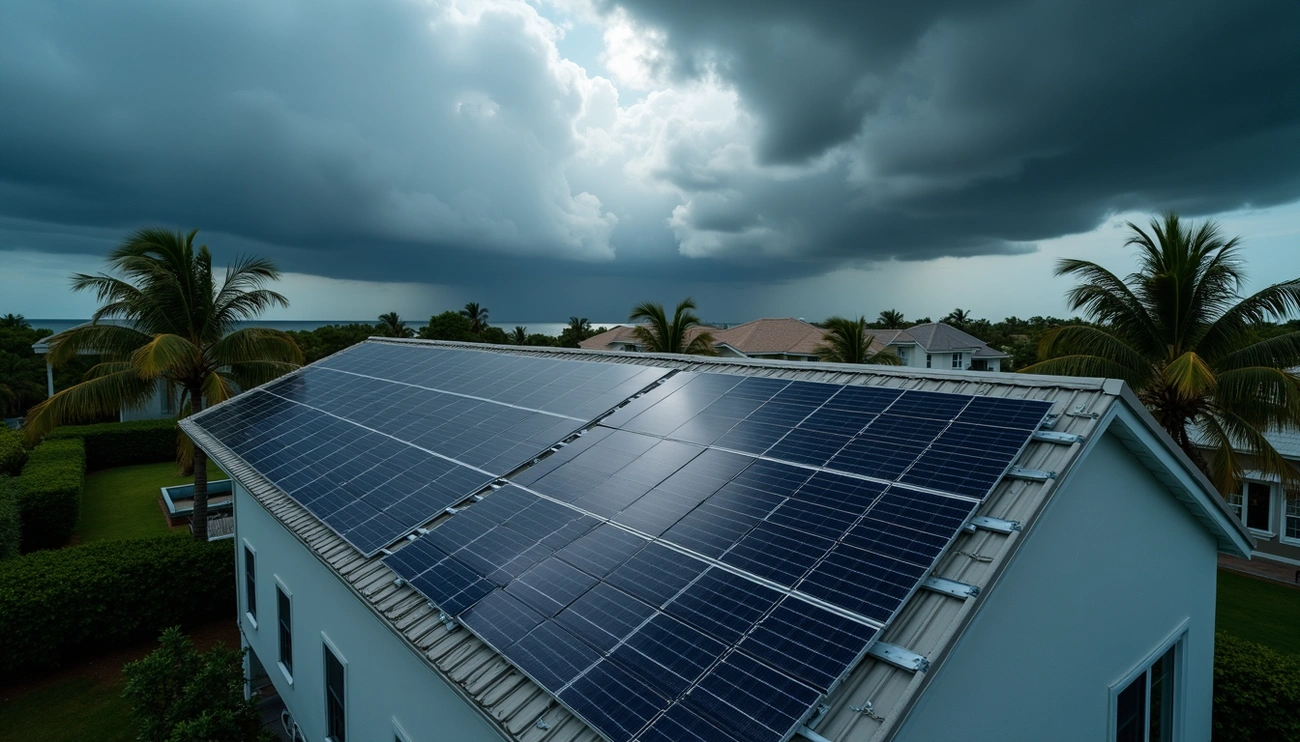
Yes, modern solar panels can withstand hurricanes when properly installed. Most panels are tested and certified for wind speeds of 140–180 mph, equal to Category 4 or 5 storms. Hurricane-rated mounting systems and code-compliant installation are critical, though flying debris can still cause damage.
How durable are solar panels in hurricanes?
Modern solar panels are engineered with remarkable resilience against hurricane conditions. Engineering specifications reveal most quality panels can withstand wind speeds between 140-180 mph, far exceeding the 129 mph threshold of a Category 3 hurricane.
Wind resistance ratings and standards
Solar panel durability is measured in pascals (Pa), with most panels rated to withstand 2,400 Pa (about 50 pounds per square foot) of wind uplift force. However, in hurricane-prone regions like Florida, local building codes demand higher standards—typically 3,300 Pa, equivalent to 160 mph wind resistance.
Notably, the American Society of Civil Engineers (ASCE) established the ASCE 7-10 standard specifically for wind resistance testing, creating a uniform national benchmark for solar installations. Furthermore, manufacturers conduct rigorous testing through push-pull pressure tests and static-load assessments to simulate extreme wind conditions.
Waterproofing and hail protection
Beyond wind resistance, hurricane-grade solar panels offer comprehensive weatherproofing. The panels and their wiring systems are completely waterproof, designed to withstand years of wind-driven rain. Their tempered glass construction—typically 3.2mm thick—provides exceptional impact resistance.
For hail protection, the International Electrotechnical Commission (IEC) 61215 standard requires panels to survive impacts from 1-inch hailstones traveling at 51 mph. Nevertheless, premium manufacturers frequently exceed these requirements, with some panels certified to withstand hailstones up to 45mm (1.77 inches) in diameter.
Common misconceptions about panel fragility
Surprisingly, the panels themselves rarely represent the weak link in solar installations during hurricanes. Most damage occurs either from flying debris or failures in the mounting system rather than panel breakage. This explains why at NREL’s Colorado campus, a severe hailstorm damaged only one panel out of 3,000 in their rooftop array.
A well-installed solar array might actually strengthen your roof structure. Each mounting rail functions like a 2×4 support, distributing turbulent loads from the roof edges toward the center. Consequently, in many storm situations, surrounding shingles fail before properly mounted solar panels give way.
What storm data tells us about solar panel performance
Real-world hurricane data provides compelling evidence of solar panel resilience. Multiple major storms have tested solar installations with remarkable results.
Hurricane Sandy: Minimal damage in New Jersey
When Hurricane Sandy struck in 2012, New Jersey had 103 megawatts of solar capacity installed. Despite the storm’s intensity, post-hurricane analysis revealed little to no damage to solar systems throughout the state. One installer who serviced over 200 customers reported only a few metal casings damaged by flooding, along with one large system where a couple of panels came loose. Even with wind speeds reaching 110 mph in some areas, the vast majority of solar arrays remained intact.
Hurricane Maria: Puerto Rico hospital case study
Perhaps the most striking example comes from Hurricane Maria in 2017. A VA hospital in San Juan featured a 645-kilowatt solar array that continued operating at 100% capacity even after exposure to 180 mph winds. This remarkable performance helped maintain critical healthcare services while much of Puerto Rico’s grid collapsed. The Hospital del Niño, which serves approximately 3,000 children across the island, also benefited from a Tesla-installed solar-plus-battery system that restored power while 75% of Puerto Rico remained without electricity.
Hurricane Ian: Babcock Ranch and other examples
In 2022, Hurricane Ian put “America’s first solar-powered town” to the ultimate test. Babcock Ranch, powered by over 650,000 solar panels, maintained electricity throughout the category-4 storm while surrounding communities went dark. The 150-megawatt solar farm and 40 MWh battery backup system kept power flowing as 90% of Charlotte County lost electricity. Key resilience features included underground power lines, solar arrays built to withstand Category 5 hurricanes, and battery storage systems.
NREL study on solar system reliability
The National Renewable Energy Laboratory (NREL) analyzed 50,000 solar installations between 2009-2013 and discovered only 0.1% reported damage or underperformance annually. Moreover, following Hurricane Florence in 2018, Duke Energy’s solar panels resumed generating power just one day after the storm, while traditional fossil-fuel plants remained offline for weeks.
How to prepare your solar system before a hurricane
Taking preventive steps before hurricane season begins can significantly increase your solar system’s chances of weathering the storm. Even if solar panels can withstand hurricanes, proper preparation remains essential for maximizing protection.
Trim trees and remove loose objects
Flying debris poses one of the most serious threats to solar panels during hurricanes. First, trim any overhanging branches near your panels to prevent them from becoming projectiles. Likewise, secure or store outdoor items such as garden furniture, potted plants, toys, and tools that could become airborne in strong winds. This simple step significantly reduces the risk of impact damage to your panels.
Take photos for insurance documentation
Obviously, documenting your system’s current condition provides crucial evidence for potential insurance claims. Take comprehensive photos of your solar equipment before storm season begins. Store these images in both digital and physical formats as verification of your system’s pre-storm condition. This documentation will prove invaluable if you need to file a claim after a hurricane.
Check battery charge and storm settings
For homes with battery systems, verify that your batteries are fully charged as the hurricane approaches. Most modern systems include a “Storm Watch” or “Weather Guard” feature that automatically responds to severe weather forecasts. This function typically charges batteries to 100% capacity and maintains that level until the storm passes. Still, manually confirming these settings provides peace of mind.
Review warranties and insurance policies
Finally, carefully review your solar warranty and insurance coverage before hurricane season. Standard homeowner’s insurance generally covers permanently attached solar panels, yet coverage details vary between policies. Confirm that storm-related damage is specifically included in your coverage. Currently, most manufacturer warranties exclude extreme weather damage, making proper insurance essential.
What to do after the storm passes
Safety becomes paramount after a hurricane passes through areas with solar installations. Proper post-storm procedures protect both your investment and personal wellbeing.
Avoid touching damaged panels
Never approach or touch damaged solar equipment after a storm. The high voltages traveling through panels can be lethal, even with automatic shutoff features. Conduct visual inspections exclusively from a safe distance, looking for obvious damage indicators such as displaced panels, cracked glass, or bent racking components. Exercise extreme caution around any downed power lines or potential electrical hazards.
Schedule a professional inspection
Contact a qualified solar installer or licensed electrician immediately for a professional assessment. These experts identify hidden hazards including microcracks, water infiltration in electrical components, and connection issues. Most utilities require notification before reconnecting any solar system that was disconnected during the storm. Allow only certified professionals to restart your system after confirming safe operation.
File insurance claims with photo evidence
Begin by turning off your system if safe to do so. Afterward, thoroughly document all visible damage with detailed photos from multiple angles. Maintain all receipts for temporary repairs and inspections. Contact your insurance provider promptly—homeowner policies typically cover roof-mounted solar panels. Provide comprehensive information about when and how the damage occurred.
Understand grid shutdown and battery use
Without battery storage, grid-tied solar systems automatically shut down during outages to protect utility workers repairing power lines. Undamaged panels with battery backup might be the only functioning power source in your neighborhood post-hurricane. Smaller battery systems like portable power stations can run critical devices for limited periods.
Conclusion
Solar panels have proven remarkably resilient against hurricane conditions, challenging common misconceptions about their fragility. Throughout this article, we’ve seen compelling evidence from multiple major storms demonstrating their durability. Consequently, homeowners in coastal regions can feel confident investing in solar energy systems designed to meet local building codes.
The statistics speak for themselves. Just 0.1% of solar systems suffer damage annually, according to NREL’s extensive study. Real-world examples further support this conclusion—from New Jersey’s solar arrays surviving Hurricane Sandy to Puerto Rico’s hospital systems maintaining power during Hurricane Maria despite 180 mph winds. Similarly, Babcock Ranch’s continued electricity during Hurricane Ian while surrounding areas lost power showcases solar’s storm resilience.
Proper preparation remains essential, nonetheless. Tree trimming, securing loose objects, and documenting your system before storm season significantly reduce risks. Additionally, understanding post-storm safety protocols protects both your investment and personal safety.