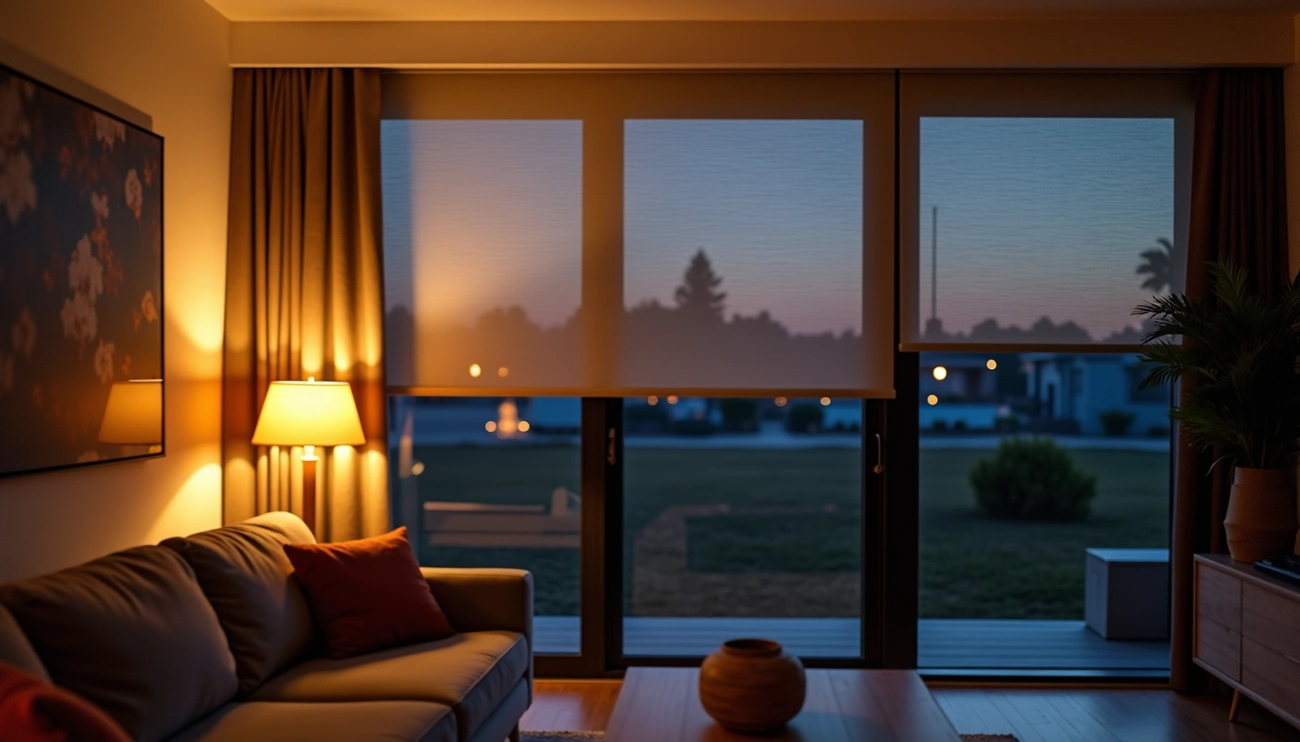
No, solar shades do not provide privacy at night. Solar shades filter sunlight and provide daytime privacy by blocking outside visibility while allowing interior views. At night, interior lighting reverses this effect. Outside viewers can see silhouettes or clear indoor details through the shade depending on the fabric weave openness (typically 1%–10%).
Why Solar Shades Don’t Provide Privacy at Night
How Light Direction Affects Privacy
Solar shades operate on a one-way vision effect, which depends entirely on light level differences between inside and outside. During the day, outdoor brightness creates a natural barrier. The shade’s exterior reflects light, blocking visibility from outside while you maintain clear views outward. At night, this dynamic flips completely. Your interior lights make your windows brighter than the dark outdoors, allowing people to see inside while your outward view diminishes.
This reversal isn’t a manufacturing flaw. Light always travels from brighter areas to darker ones, and solar shades can’t override basic physics. When you flip on indoor lighting, light moves outward through the fabric weave. Outsiders can spot silhouettes and clear interior details, depending on your shade’s fabric openness.
The Fishbowl Effect Explained
The fishbowl effect ranks as the number one privacy complaint with solar shades. Your warmly lit interior becomes much brighter than the street outside after dark. This brightness difference causes the shade to turn transparent from an external viewpoint, regardless of how tight the weave is.
Most light-filtering blinds, including solar shades, zebra blinds in sheer mode, and translucent fabrics, allow complete visibility at night when lights are on. Your home becomes a brightly lit display from the outside, while you can’t see out at all. The openness factor percentage only refers to UV light filtering, not nighttime opacity.
Daytime vs Nighttime Privacy Differences
You can see outside during the day, but passersby cannot see into your home. Solar shades provide excellent daytime privacy since anyone looking in won’t be able to see through from outdoors. However, when interior lights are on at night, this effect gets reversed. The privacy effect disappears as light travels outward. Solar shades are designed for daytime privacy only.
Understanding Solar Shade Openness and Transparency
What Do Openness Percentages Mean?
Openness percentage refers to the tightness of your solar shade’s fabric weave. A lower percentage means a tighter weave, which blocks more light and offers greater privacy. The percentage determines how much light passes through, affecting privacy, glare reduction, and UV protection. Solar shades generally range from 1% to 10% openness. Lower openness values between 1% and 5% block more sunlight, offering maximum privacy and protecting furniture from UV damage. Medium openness at 5% to 7% balances natural light and privacy. Higher openness at 10% to 14% allows more visibility and natural light but reduces privacy, especially at night.
1% Solar Shades at Night: Do They Help?
Even 1% solar shades do not provide privacy at night. While they block 99% of UV rays, they still allow people to see inside your home once your interior lights are on. Silhouettes and movement will be visible from the outside. The openness factor percentage only refers to how much UV light is filtered, not how opaque the shade is at night. A 1% weave blurs the view significantly from the street, making your windows look like glowing panels rather than transparent glass. However, while they obscure fine details better than a 10% fabric, they absolutely will not provide the level of privacy required for a bedroom or bathroom.
3% vs 5% vs 10% Transparency Levels
A 3% shade blocks 97% of UV rays and is less transparent, providing a bit of privacy. At 5% openness, the shade blocks 95% of UV rays and is semi-transparent, providing less privacy. If your indoor lights are on, a passerby can clearly distinguish furniture, people, and even what’s playing on your television. A 10% shade blocks 90% of UV rays and is the most transparent, providing minimal privacy.
How Color Impacts Nighttime Visibility
Dark fabrics like black, bronze, or charcoal absorb light and glare, providing the best view out during the day. However, they can make the interior more visible from the outside at night if the lights are bright enough. Light colors like white, cream, or beige reflect light. At night, a white solar shade reflects the indoor artificial light, which can slightly improve privacy by creating a wall of light effect, but this is marginal.
Proven Solutions for Solar Shades Privacy at Night
If you already own solar shades and want privacy at night, you don’t need to replace them. Several practical solutions can solve the privacy problem while keeping the daytime benefits.
Layer with Blackout Roller Shades
A blackout roller shade layered behind your solar shade provides complete privacy and darkness when needed. You can use the solar shade during the day to reduce glare and UV rays, then lower the blackout shade at night for full privacy. This dual-layer design allows you to switch between soft, diffused light and complete privacy.
Install a Dual Shade System
Dual shade systems combine both fabrics in a single assembly. The solar screen blocks heat and glare without blocking the view, while the blackout fabric stops light from passing through the fabric into the room. You can operate the sunscreen shade and the blackout shade independently, giving you flexibility to control each layer separately. This setup uses a single rod for both blinds, taking up less space in the drapery pocket.
Add Curtains or Drapes Over Solar Shades
Layering solar shades with blackout drapery gives you full night privacy while enjoying reduced glare and blocked UV rays by day. Keep your solar shades down during the day for light control, then close the curtains at night for complete privacy. This pairing offers precise control over light and privacy, with shades handling the heavy lifting and curtains providing an additional layer.
Use Window Films for Extra Privacy
Frosted or tinted window films can reduce nighttime visibility while keeping your daytime view. However, reflective films with one-way mirror effects will not provide privacy at night. When indoor lights are on after dark, the interior of the building will be visible.
Keep Interior Lighting Low
Bright indoor lighting increases nighttime visibility through any shade. Dimming your lights reduces the brightness difference between inside and outside, minimizing how much people can see in.
Best Window Treatments for Complete Nighttime Privacy
If you’re starting fresh with new window treatments, several options deliver complete nighttime privacy without the transparency issues of solar shades.
Blackout Cellular Shades
Blackout cellular shades have a mylar lining that blocks light from passing through in either direction. People outside can’t see anything, not even shadows, regardless of how bright your indoor lights are. Double cell designs stack two rows of cells within each shade, creating an extra barrier that enhances privacy by reducing silhouette visibility when lights are on. Single cell shades work well for living rooms where moderate privacy suits your needs, while double cell shades excel in bedrooms requiring stronger evening coverage.
Plantation Shutters
Plantation shutters offer excellent light control but are not fully blackout on their own. Light may filter through tiny gaps between the louvers or around the edges of the frame. However, pairing shutters with a built-in blind creates a highly effective blackout solution. Larger-sized louvers minimize light seepage since fewer gaps exist.
Light-Filtering Roller Shades
Blackout roller shades offer full privacy during the day and nighttime, making them ideal for bedrooms and bathrooms. Note that light-filtering roller shades differ from blackout versions and won’t provide complete nighttime privacy.
When Solar Shades Still Make Sense
Solar shades work well in living spaces and offices where you prioritize view preservation and UV protection over nighttime privacy.
Conclusion
Solar shades work beautifully during daylight hours, but they don’t provide privacy at night when your lights are on. This happens because of light direction, not fabric quality. Given that you now understand this limitation, you can choose the right solution for your home. Layering with blackout shades or curtains gives you the best of both worlds: UV protection and view during the day, complete privacy after dark. Pick the option that fits your lifestyle and budget.